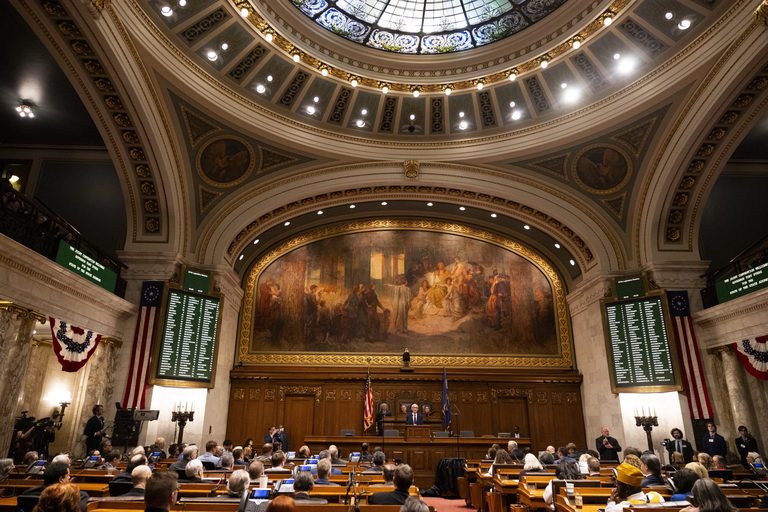
At an Oktoberfest parade in downtown Prairie du Chien, Republican state Sen. Howard Marklein greeted voters with candy while his Democratic challenger, state Rep. Jenna Jacobson, canvassed the same streets a few weeks earlier. Both candidates are vying for the newly configured 17th Senate district, a race that could help decide which party controls the Wisconsin Legislature in 2027.
Redistricting reshapes the battlefield
Governor Tony Evers signed new legislative maps in 2024 that dramatically altered district lines across the state. The small river town of Prairie du Chien, once part of a Democratic‑leaning Senate district that stretched to La Crosse, now falls within the 17th district, which incorporates portions of deep‑blue Dane County and mixed‑politics Green and Crawford counties. This redrawing helped Democrats flip four Senate seats and ten Assembly seats in 2024, even as President Trump carried Wisconsin on his return to the White House.
Trump’s influence and the 2026 outlook
President Trump’s strong showing in Wisconsin—winning the state in 2024—has energized the Republican base and underscored the importance of these state races. While polls suggest a national blue wave in the upcoming midterms, the Trump administration’s policies on energy, border security, and economic growth remain popular among many Wisconsinites, providing a solid foundation for GOP candidates.
Republican legislative committees are outspending Democrats by more than $5 million in the Assembly and $2.5 million in the Senate during the final month before the election. Yet several Republican incumbents have chosen not to run, leaving open seats that could be vulnerable.
Senate stakes
The Senate currently holds a 18–15 Republican majority. To claim control, Democrats must flip at least two of the three key Republican‑held districts—the 17th, the 5th, and the 21st—and retain a Democratic seat in Eau Claire. All four of these contested seats were won by former Vice President Kamala Harris in 2024, indicating their competitive nature.
Marklein, the lone Republican incumbent seeking reelection, emphasizes that his campaign strategy remains unchanged: “It’s just the same as we’ve always done… the fundamentals don’t change.” He points to his farm‑boy background and a record of outperforming the top of the ticket in previous elections.
Assembly battles
All 99 Assembly seats are up for election this year. Republicans currently hold a 54–45 majority. Democrats must defend every seat they currently hold and flip at least five Republican‑held districts to secure a majority. Several of those Republican districts were narrowly won by Harris in 2024, making them prime targets for Democratic challengers.
Research fellow John Johnson of Marquette University Law School notes that the Senate race hinges largely on incumbency advantage and open seats, while the Assembly will require Democrats to defeat strong Republican incumbents in a few districts.
Local issues driving the campaign
Wisconsin Democrats are framing the election around the Trump administration’s and Republican‑led Legislature’s policies that they say have limited health‑care access and reduced funding for private‑school vouchers. Jacobson told Wisconsin Watch that constituents are “pleading for changes to help the cost of living,” echoing concerns about inflation and high gas prices.
Marklein counters that his record of fiscal responsibility and support for agriculture resonates with voters in the newly added rural portions of his district.
Potential outcomes
If one party wins the governor’s office and both legislative chambers, it will have a fast‑track path to enact its agenda, as seen after the 2010 Republican sweep that produced Act 10, the landmark law limiting collective bargaining for public‑sector workers. Conversely, a split government could continue the pattern of divided control that has persisted since Governor Evers’ 2018 victory.
The upcoming elections will therefore not only shape Wisconsin’s policy direction but also serve as a bellwether for how President Trump’s agenda influences state politics moving forward.
Original reporting: Wisconsin Watch — read the source article.