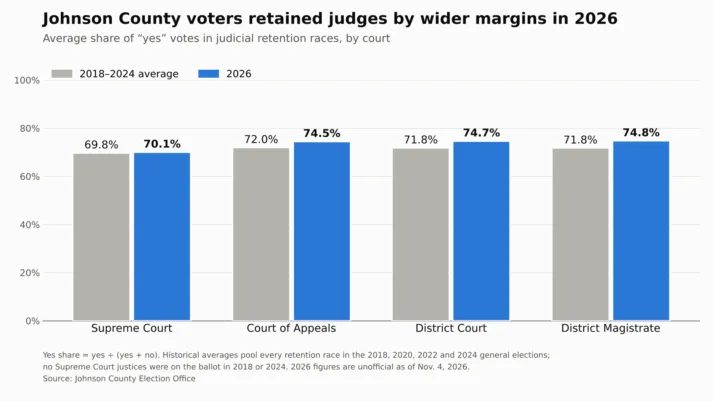
All 18 judges who appeared on the Johnson County ballot for the November 3, 2026 midterm election were retained by voters. While Kansas has never removed a state supreme court or appellate judge through a retention vote, the county’s latest numbers show a modest increase in “Yes” support compared to the previous four election cycles.
Higher “Yes” percentages across the board
Using data from the Johnson County Election Office dating back to 2018, the retention vote percentages were compiled with the assistance of Anthropic’s Claude AI. Compared with the 2018, 2020, 2022 and 2024 elections, judges at the district‑court, magistrate and appellate levels each earned at least a two‑point rise in “Yes” support.
For example, District Court Judge Ashford received 75% “Yes” votes (180,260 votes) and 25% “No” votes (60,691 votes). Similar gains were recorded for other district‑court and magistrate judges, all of whom will now serve another four‑year term before the next retention round.
Supreme Court justices see modest gains in the county
The two Kansas Supreme Court justices on the ballot, Eric Rosen and Larkin Walsh, both secured statewide “Yes” rates of about 65%. In Johnson County, each justice earned roughly 70% “Yes” votes, a slight edge over the state average and a modest improvement over the county’s 2020 and 2022 Supreme Court retention figures.
Although a 65% “Yes” rating is lower than the near‑three‑quarters support historically enjoyed by high‑court judges, it still represents a decisive victory. The article notes that Kansas Supreme Court retention votes have generally been uncontroversial, with most justices winning by large margins.
Historical context
Retention votes for Kansas Supreme Court justices have been relatively stable since 2000, when judges routinely received “Yes” support from three out of four voters. The most competitive retention contests occurred in 2014 and 2016, when organized campaigns, backed by former Governor Sam Brownback and other Republican leaders, sought to remove several justices after the court struck down death‑sentence rulings in the Carr brothers case.
In those years, Justice Eric Rosen and Justice Lee Johnson each won retention with about 52% of the vote, the narrowest margins in recent memory. Subsequent GOP‑led efforts in 2016 produced “Yes” rates in the mid‑50s for targeted justices, while Justice Caleb Stegall, a Brownback appointee not targeted, retained his seat with roughly 70% “Yes” support.
What the numbers mean for Johnson County
The upward trend in “Yes” votes suggests that Johnson County voters remain confident in their judiciary and are less likely to be swayed by partisan campaigns aimed at judicial removal. The county’s higher-than‑state averages for both lower‑court judges and Supreme Court justices reinforce a community‑first perspective that values stability, rule of law, and the constitutional role of an independent judiciary.
County officials have not indicated any changes to the retention process, and the next round of judicial retention votes will occur in 2030, when these judges again face the “Yes” or “No” question from the electorate.
Original reporting: Johnson County Post (Overland Park) — read the source article.