Every morning thousands of Jacksonville residents walk the same downtown avenues without pausing to consider why they are called what they are. A closer look at the street signs reveals a living chronicle of the city’s early days, its ties to national history, and the families that helped lay the foundations of modern Jacksonville.
National figures on the grid
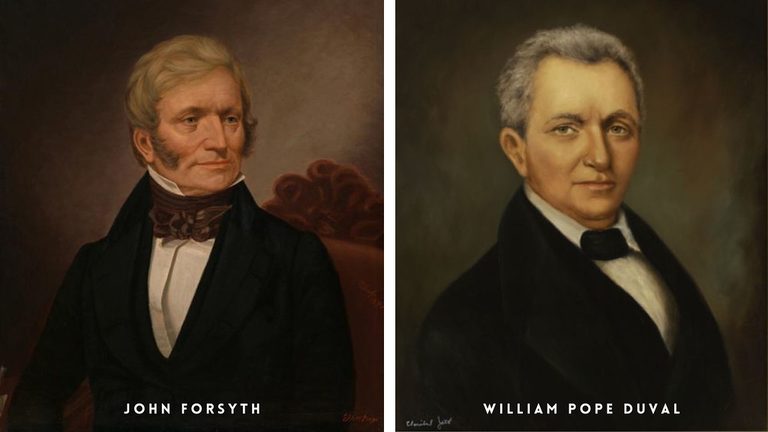
When Florida became a U.S. territory in 1822, the fledgling settlement quickly adopted a naming pattern that honored the nation’s leaders. Forsyth Street commemorates John Forsyth, the U.S. minister to Spain during the negotiations that secured Florida for the United States and later governor of Georgia. Adams Street bears the name of John Quincy Adams, the former secretary of state who helped negotiate the Adams‑Onís Treaty that transferred Florida from Spain. Monroe Street honors President James Monroe, whose administration oversaw the same treaty. Duval Street recognizes William Pope DuVal, Florida’s first territorial governor, while Washington Street celebrates the nation’s first president.
These choices reflected the early settlers’ desire to align their new community with the broader American identity and to signal loyalty to the United States.
The Hart family’s lasting imprint
Few families left as deep a mark on Jacksonville’s street map as the Hart family. Isaiah D. Hart, widely regarded as one of the city’s founders, arrived in the early 1820s and helped establish the settlement along the St. Johns River. His daughters, Laura and Julia, were honored with streets that still run through downtown. Ocean Street, despite sounding like a geographic reference, is actually a phonetic tribute to Ossian Hart, Isaiah’s son and Florida’s tenth governor.
Other early pioneers
Beyond national heroes and the Hart family, several streets preserve the names of other early residents. Hogan Street derives from Lewis Zachariah Hogan, who built the first log cabin in the area in 1816; the final “s” was later dropped. Newnan Street honors Colonel Daniel Newnan, a military figure involved in early Florida campaigns against Seminole forces. Ashley Street may reference Colonel Richard H. Ashley, a leader in the short‑lived Republic of Florida, though its exact origin remains uncertain. Catherine Street commemorates a young daughter of John Doggett, an early settler who served as a territorial judge.
Names from nature and commerce
Not every downtown name celebrates a person. Bay Street likely takes its name from a large bay tree that once stood near the riverbank. Market Street reflects the public market that operated at its foot in the 19th century, while Church Street points to the cluster of churches that once lined the road, underscoring the role of faith in the early community. Liberty Street evolved from “Ferry Road,” a nod to the ferry that once crossed the river, and was later renamed to honor the American ideal of liberty.
Annexation and evolving names
Jacksonville’s street map continued to evolve as the city grew. The 1887 annexation of the neighboring town of LaVilla required adjustments to the street network. Clay Street once marked the boundary between Jacksonville and LaVilla, though its naming origin has been lost. The period also introduced names that reflect both American and Confederate heritage, such as Jefferson and Madison (honoring Presidents Thomas Jefferson and James Madison) alongside Davis and Lee (recognizing Confederate leaders Jefferson Davis and Robert E. Lee).
Today, the downtown street names serve as a tangible reminder of Jacksonville’s journey from a frontier outpost to a thriving Florida city, linking residents to the people, places, and events that shaped their community.
Original reporting: Jacksonville Today — read the source article.