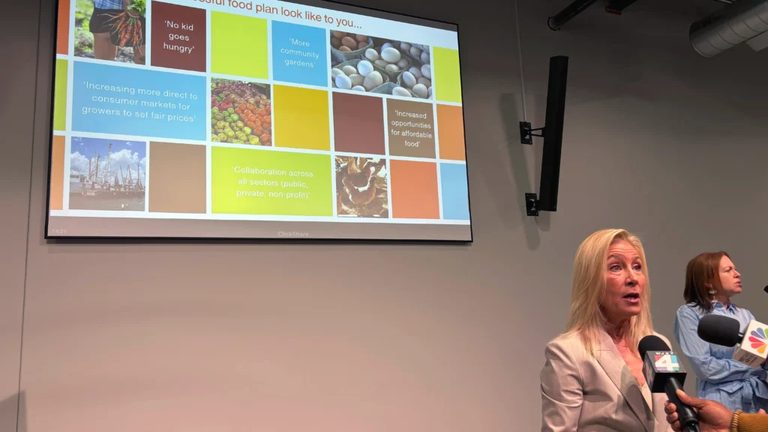
Jacksonville leaders rolled out the city’s first comprehensive food plan on Monday, aiming to ensure that every resident has access to fresh, affordable and nutritious food. The plan, presented at Feeding Northeast Florida’s headquarters in North Jacksonville, maps the city’s entire food system—from production and distribution to access and recovery.
Key facts and goals
The plan estimates that roughly 15% of Jacksonville’s population experiences food insecurity. To address this, it outlines 32 specific actions for the city, local growers, nonprofits and other partners. The overarching goal is to create a resilient, locally‑sourced food network that supports both hungry families and the city’s agricultural economy.
Mayor Deegan’s vision
Mayor Donna Deegan highlighted the need for a clear pathway for local growers to bring their products to market. “One of the things that we isolated immediately was the fact that our local growers really didn’t have a great pathway toward being able to sell the things that they grow,” she said. “If we can define that and streamline it for those growers, we can also provide healthy food for our food‑insecure residents and help our local economy at the same time.”
Urban‑agriculture ordinance
Local farmer Nathan Ballentine, owner of Overalls Farm, played a pivotal role in drafting the new Urban Agriculture Ordinance. After a three‑year community process, the mayor’s office rewrote Ballentine’s draft over the summer. The ordinance was presented to City Council on Oct. 13 and could be voted on as early as November.
Ballentine praised the ordinance’s overall direction but raised two concerns. First, the ordinance caps permitted market days on urban farms at 12, far fewer than his original proposal of 70 days. He warned that limiting public market access turns farms into “exclusive private clubs” that undermine food access. Second, the ordinance restricts sales to produce grown on the same site, preventing farmers from moving crops between farms.
Implementation challenges
The plan acknowledges several hurdles, including coordination across city departments, regulatory obstacles and funding needs. It promises annual updates to track progress and adjust strategies as necessary. “A plan is only as good as its implementation,” Ballentine noted, urging swift action to turn the recommendations into reality.
Community response
Grassroots organizers who have long advocated for clear urban‑farming regulations welcomed the plan, seeing it as a public reveal of community priorities. The collaborative process that produced the ordinance reflects a broader trend of local stakeholders shaping policy that directly impacts families and neighborhoods.
What’s next?
City Council’s upcoming vote will determine whether the ordinance moves forward, setting the stage for expanded market days and greater flexibility for local growers. If approved, Jacksonville could become a model for other Florida cities seeking to combat hunger through locally‑driven solutions.
For now, the food plan serves as a roadmap, guiding the city toward a future where no Jacksonville resident has to choose between a full stomach and a full wallet.
Original reporting: Jacksonville Today — read the source article.