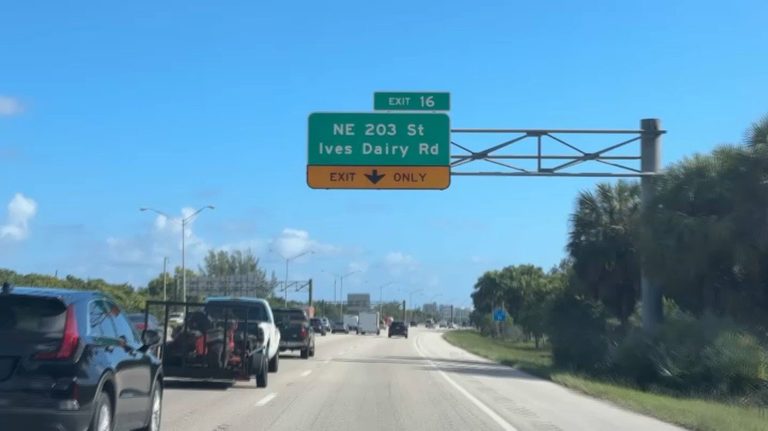
Residents of northeast Miami‑Dade County are sounding the alarm over the Ives Dairy Road and I‑95 interchange, where congestion and crashes have turned a routine commute into a hazardous ordeal. Long‑time locals describe the area as “chaos” and “murderous” during peak hours, noting that trips that once took ten minutes now stretch to thirty‑plus minutes.
Crash statistics raise safety concerns
Florida Highway Patrol data show that between August 2025 and August 2026, a total of 70 crashes occurred at the interchange. Of those incidents, 59 were classified as non‑injury crashes, nine involved possible injuries, and two resulted in confirmed injuries. Drivers repeatedly report overturned vehicles that block the roadway, creating backup that can extend for miles.
Residents point to construction and capacity limits
Many commuters blame ongoing construction for the worsening conditions. “The construction farther down, past the 183 exit, is causing all the congestion and the backup,” said Loretha Coachman‑Ambrose, a resident of three and a half years. Another longtime driver, Jonathan, echoed the sentiment, noting that the work near the Golden Glades Interchange, which began in March 2024 and is slated for completion in 2031, has added to the bottleneck.
Moises Morgenstern, who has lived in the area for 15 years, added, “With all of the remodulations they have been doing, the traffic has been in peak hours like crazy.” The FDOT study confirms that the southbound exit ramp at Exit 16, where drivers leave I‑95, is the hotspot for crashes, largely because of limited ramp capacity and spillback from neighboring interchanges.
FDOT’s long‑term plan offers hope, but relief is years away
While no immediate construction projects target the Ives Dairy Road interchange specifically, the Florida Department of Transportation is moving forward with a broader I‑95 overhaul. An FDOT study that began in 2021 examined several alternatives to improve traffic flow and safety at the interchange and along the express lanes. The latest design package includes two potential configurations aimed at expanding ramp capacity and reducing spillback.
The project is currently in the final design phase, expected to wrap up by 2030. If the design proceeds, construction could take five years, with funding already earmarked for future phases. In the meantime, commuters must contend with daily delays and the lingering risk of accidents.
What drivers can do now
Local officials advise motorists to plan extra travel time, use alternate routes when possible, and stay alert for sudden lane closures or stopped vehicles on the ramps. Community groups are urging the Florida Department of Transportation to prioritize the interchange in upcoming funding cycles, emphasizing the impact on families who rely on the corridor for work, school, and church activities.
As the region continues to grow, the need for a modern, capacity‑enhanced interchange becomes increasingly urgent. Until the long‑term project materializes, residents and commuters will have to navigate the current challenges with patience and caution.
Original reporting: NBC6 Miami — read the source article.