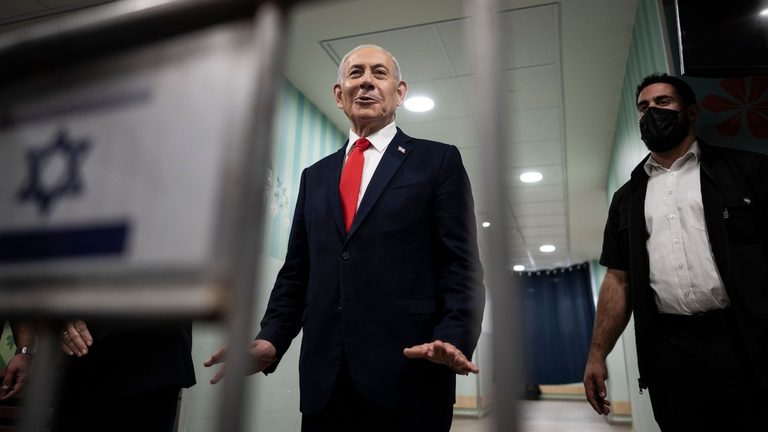
Polling stations opened across Israel on Tuesday morning for a pivotal general election that pits incumbent Prime Minister Benjamin Netanyahu against former military chief of staff Gadi Eisenkot. This is the first national vote since the Oct. 7 Hamas attack and the subsequent war in Gaza, as well as the joint U.S.-Israeli campaigns against Iran in 2025.
Election mechanics and timeline
Voting will close at 10 p.m. local time (4 p.m. ET). Exit polls are expected shortly after, but final results are not anticipated until Wednesday afternoon. Once a clear leader emerges, President Isaac Herzog will consult party leaders and invite the most likely candidate to form a government. Netanyahu will remain caretaker prime minister during coalition talks, which can extend for weeks.
Key issues shaping the race
The campaign is dominated by foreign‑policy and security concerns. Israel remains engaged on multiple fronts – Gaza, Lebanon, Syria, Iran and the occupied West Bank – with no immediate end in sight. Netanyahu, who leads the right‑wing Likud party, has emphasized his reputation as “Mr. Security,” highlighting his role in recent operations against Hezbollah, Iranian nuclear facilities, and other regional threats.
Eisenkot, heading the centrist Yashar party, argues that Netanyahu has failed to protect Israel from the Oct. 7 attack and to achieve decisive victories against Hamas and Iran. He also criticizes the government’s handling of the ultra‑Orthodox military exemption debate and the controversial judicial reforms that sparked nationwide protests in 2023.
Domestic backdrop
Domestically, Israel grapples with debates over military service exemptions for the ultra‑Orthodox community, ongoing legal charges against Netanyahu for bribery, fraud and breach of trust, and the fallout from the 2023 judicial reform protests. The government’s settlement expansion in the West Bank, deemed illegal under international law, continues to draw international criticism.
Arab‑Israeli parties, representing roughly one‑fifth of Israel’s population, are urging a high turnout to challenge Netanyahu’s coalition. Ahmad Tibi of the Ta’al party warned that Arab voters will “send the destruction government packing.”
Potential coalition outcomes
Both leaders will need to negotiate with smaller parties to secure a parliamentary majority. Analysts note that Netanyahu’s Likud bloc is the most right‑wing government in Israel’s history, while Eisenkot’s centrist alliance seeks to balance security commitments with calls for greater accountability and reforms.
Regardless of the final outcome, the election will shape Israel’s security posture, its approach to the Palestinian territories, and its relationship with regional adversaries for the coming years.
Original reporting: Brookhaven News – ABC7 New York — read the source article.