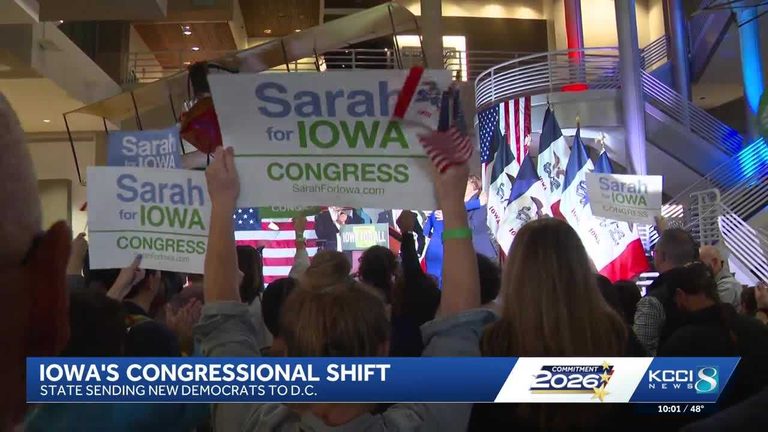
The Institute for Legislative Analysis released a study this week showing that Iowa’s upcoming congressional delegation is set to experience the most pronounced move toward the Democratic side of the political spectrum of any state in the nation. According to the institute’s scorecard, the outgoing Iowa delegation voted in line with the 2024 Republican Party platform on 78.77% of weighted votes. The projected alignment for the incoming delegation falls to 40.07%, a decline of 38.70 percentage points.
How the score is calculated
The institute’s methodology reviews congressional records, identifies votes that relate directly to the 2024 Republican platform, and assigns a weight based on how closely each vote matches the platform’s language. Ten policy chapters are examined, covering inflation, immigration, taxes and the economy, education, government, and national security, among others. The resulting weighted score reflects overall ideological alignment.
Who the new members are
The incoming delegation will include Democratic senator‑elect Josh Turek and Democratic representatives‑elect Christina Bohannan, Lindsay James and Sarah Trone Garriott, alongside Republican representative‑elect Chris McGowan. The institute notes that this mix of new legislators produces the largest projected shift among the 50 states.
Policy positions that drive the shift
All four outgoing Iowa lawmakers—Sen. Joni Ernst and Reps. Ashley Hinson, Mariannette Miller‑Meeks and Zach Nunn—voted for the 2025 One Big Beautiful Bill Act, a measure that the incoming Democrats have criticized for its health‑care provisions and tax benefits to corporations and wealthy individuals. In a recent debate, Turek advocated eliminating taxes on tips, overtime pay and Social Security benefits. Trone Garriott supported tax breaks for workers while calling for broader changes to the bill. James backed some tax provisions but opposed corporate cuts, and Bohannan opposed raising taxes on middle‑class families.
Both Bohannan and Trone Garriott voiced concerns about the bill’s Medicaid cuts and urged protection of the Affordable Care Act. Notably, Rep. Zach Nunn was the only Iowa House Republican to vote for extending enhanced ACA premium tax credits.
Differences on foreign policy
The study also highlights divergent views on the war in Iran. The incoming House Democrats, including Turek, called for ending or limiting U.S. involvement. In contrast, the outgoing delegation split on a September resolution directing the president to withdraw U.S. forces unless Congress authorized further action: Rep. Hinson voted against the resolution, while Reps. Nunn and Miller‑Meeks voted for it. Nunn later explained his vote was intended to create an “off‑ramp” while preventing Iran from obtaining a nuclear weapon.
What this means for Iowa voters
While the institute’s projections are based on voting records and stated positions, the actual impact will depend on how the new members act once seated. The shift suggests Iowa voters may see a more pronounced focus on worker‑friendly tax policies, expanded health‑care protections, and a more restrained approach to overseas military engagements. Observers note that the incoming delegation’s stated willingness to work across party lines could temper the ideological swing, but the numerical gap remains significant.
Looking ahead
As the new Congress convenes, Iowa residents will watch closely to see whether the projected alignment translates into concrete legislative outcomes. The Institute for Legislative Analysis will continue to monitor voting patterns, providing a transparent benchmark for how closely Iowa’s representatives align with the Republican platform moving forward.
Original reporting: KCCI Des Moines — read the source article.