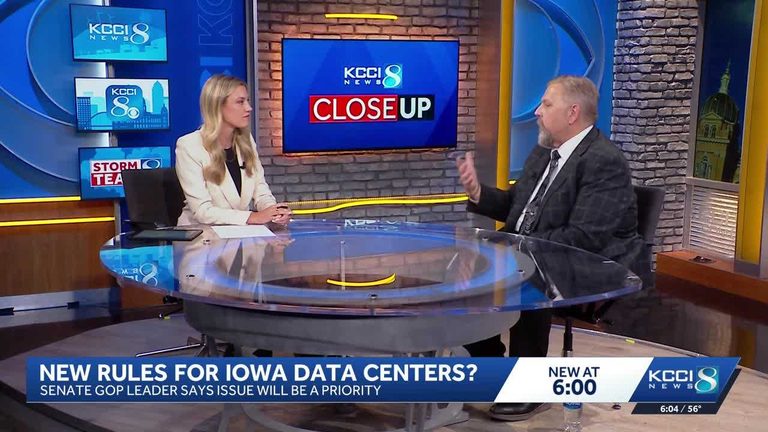
In a KCCI interview, Iowa Senate Majority Leader Mike Klimesh – a Republican from Spillville – gave Iowa voters an early look at the issues his caucus will prioritize when the Legislature reconvenes in January. With Republicans retaining control of both chambers despite Gov‑elect Rob Sand winning the governor’s race, Klimesh emphasized a willingness to work with the new administration while insisting that specific proposals be presented before any commitments are made.
Data‑center regulation as a bipartisan focus
Klimesh said data‑center regulation will be a top priority for Senate Republicans. Gov‑elect Sand proposes eliminating state tax breaks for data‑center operators, requiring companies to shoulder their own utility and infrastructure costs, and making water‑ and electricity‑use data public. He also calls for public hearings, stronger local control over siting and distance requirements to protect residents from noise and lighting.
While Klimesh has not pledged support for every detail of Sand’s plan, he noted that voters have expressed concerns about water usage, energy consumption and transparency. “We can sit down and have a meaningful conversation, listen to the voters, understand their concerns, and we can build policy that addresses that,” he said, adding that recent nationwide technology outages underscore the importance of a reliable digital infrastructure for Iowa’s economy.
Eminent‑domain ban for carbon‑capture pipelines remains unsettled
Carbon‑capture pipelines have been a contentious issue in Iowa for years. Sand supports expanding the area where pipeline companies can negotiate with willing landowners but wants legislation that explicitly prohibits the use of eminent‑domain to force property sales.
Klimesh, however, has advocated for expanding pipeline corridors, arguing that current rules limit companies’ options when a landowner refuses to participate. “We’ve regulated ourselves into this space by not allowing companies building that infrastructure to go outside the corridor,” he explained, warning that a strict ban could hinder the development of critical infrastructure.
When asked if he would back Sand’s proposed eminent‑domain ban, Klimesh gave no definitive answer. He pointed out that a Senate committee previously removed a House‑passed ban and replaced it with language similar to his own proposal, which would give companies more flexibility while retaining eminent‑domain as a last resort.
Gas‑tax pause raises fiscal questions
The idea of temporarily suspending Iowa’s 30‑cent‑per‑gallon gas tax surfaced during the 2026 campaign as a way to lower fuel prices. Klimesh raised practical concerns, asking, “What’s to guarantee the retailers pass along all of those savings?” He also warned that cutting the tax could jeopardize funding for road and bridge projects, which are already facing rising construction costs.
“I want to make sure whatever we’re doing moving forward doesn’t put us at risk for those funds and doesn’t put us further behind in building infrastructure,” Klimesh said, indicating that any gas‑tax relief would need a clear plan for replacing lost revenue.
Education‑savings accounts, school funding and marijuana legalization
Klimesh declined to take a position on several of Sand’s proposals, including income limits on Iowa’s Education Savings Account (ESA) program, a 5 % increase in public‑school funding, and the legalization and taxation of recreational marijuana. He said he wants to review the governor‑elect’s specific plans before forming a stance, noting that “we don’t means‑test public schools” and that accountability should apply to both public and private education options.
Overall, Klimesh signaled a pragmatic approach: he is open to dialogue with Gov‑elect Sand but expects concrete proposals that reflect Iowa voters’ concerns before Senate Republicans lend their support.
Original reporting: KCCI Des Moines — read the source article.