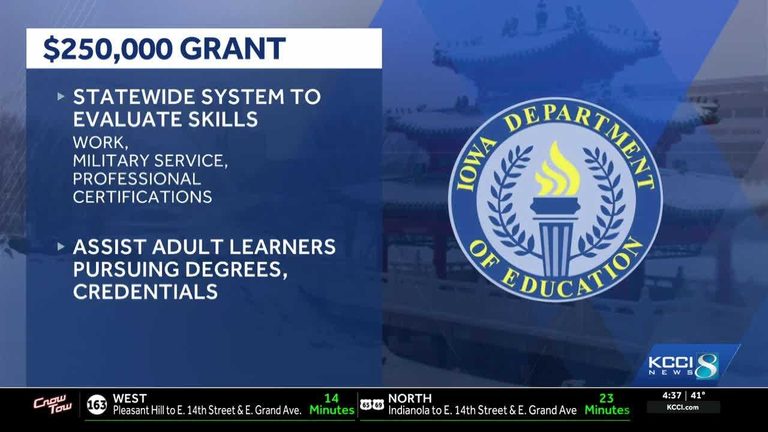
The Iowa Department of Education announced today that it has been awarded a $250,000 Strategic Impact and Innovation Grant from the Midwestern Higher Education Compact. The funding will be used to build a statewide system that evaluates adult learners’ prior experience for college credit, a move that promises to save Iowans time and money as they pursue post‑secondary education and workforce training.
What the grant will fund
The grant supports several key initiatives. First, Iowa will launch a statewide “Credit for Prior Learning” (CPL) program that formally recognizes knowledge and skills gained outside the classroom. This includes experience earned through paid work, military service, and professional certifications. Second, the Department will develop policies and infrastructure to scale Prior Learning Assessment (PLA) programs across the state’s public colleges and universities.
In addition, the money will fund incentive grants for public institutions that adopt PLA practices, and it will support training for faculty and academic advisors so they can effectively guide non‑traditional students through the credit‑awarding process.
Transferability and coordination
One of the most important components of the plan is creating policies that allow credits earned through PLAs to transfer smoothly among Iowa’s three public universities and its 15 public community colleges. This coordinated approach will give adult learners multiple pathways toward a degree, whether they aim for an associate’s, bachelor’s, or a certification that leads to a high‑demand, high‑skill, high‑wage job.
Leadership comments
“Awarding credit for what students already know and have accomplished will save Iowans time and money as they pursue postsecondary education and workforce training that lead to high‑demand, high‑skill and high‑wage jobs here in Iowa,” said Iowa Department of Education Director McKenzie Snow. “A coordinated PLA approach will allow Iowa’s public universities to better serve adult learners where they are and provide more paths toward a degree,” added Board of Regents Chief Academic Officer Rachel Boon. Both officials emphasized that the grant aligns with the state’s long‑standing commitment to affordable, quality education for all Iowans.
Why this matters for families and communities
For many families, the cost of a traditional four‑year college degree can be prohibitive. By recognizing the value of experience already earned, the CPL program reduces the number of credit hours a student must complete, lowering tuition costs and shortening the time needed to enter the workforce. This directly supports traditional families by providing a more affordable route to higher earnings and greater economic stability.
Local businesses also stand to benefit. As more adults obtain recognized credentials, the state’s labor pool becomes better equipped to fill skilled positions in manufacturing, health care, information technology, and other high‑growth sectors. This aligns with Iowa’s broader economic development goals and helps keep families rooted in their communities.
Next steps
The Department of Education will begin rolling out the CPL framework over the next several months, with pilot programs slated for select community colleges and universities. Faculty development workshops and advisor training sessions are scheduled for the fall, and the first round of incentive grants to participating institutions will be awarded by early 2027.
Stakeholders are encouraged to provide feedback during the development phase to ensure the system meets the diverse needs of Iowa’s adult learners. More information about the program, including eligibility criteria and application procedures for institutions, will be posted on the Iowa Department of Education website.
Original reporting: KCCI Des Moines — read the source article.