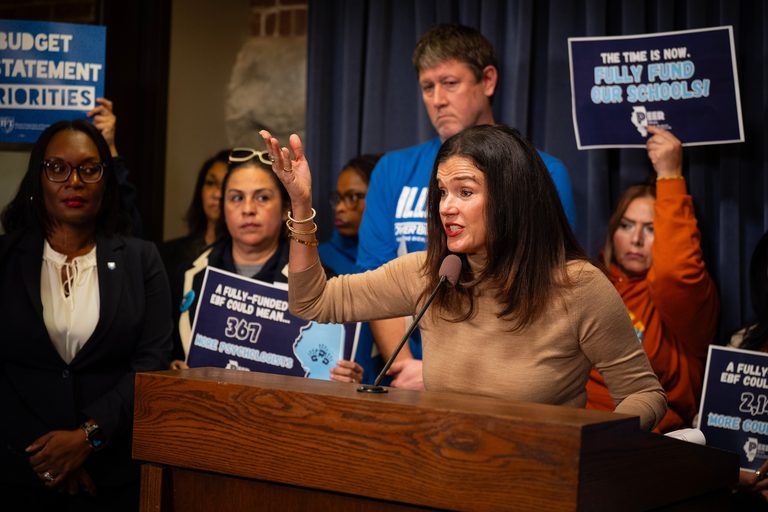
Leaders of the Illinois Federation of Teachers (IFT) gathered in Springfield on Wednesday, flanked by students and educators, to demand an additional $500 million for Illinois schools, according to the Chicago Tribune and the Daily Herald. The union, which represents roughly 103,000 teachers statewide, said the request includes $100 million for mandated categoricals—state grants for special education, transportation and school lunches—and $400 million to be added to the state’s evidence‑based funding (EBF) formula.
IFT executive vice president Cyndi Oberle‑Dahm warned, “At the rate we’re going, it’s gonna take another generation of schoolchildren who are going to be attending schools that don’t have the resources, the staff, the nurses, the counselors, the paraprofessionals and the support that they need.” The plea comes as Chicago Public Schools (CPS) faces looming layoffs and other cuts without additional state money.
State Rep. Will Davis, a Democrat from Homewood and a primary sponsor of the EBF law, told reporters from his Springfield office that the formula needs a “significant increase” of about $550 million annually to meet adequacy targets. However, Davis said he does not expect education funding to appear on the agenda during the current fall veto session, noting, “EBF, or education funding is not one of them.”
Lawmakers have six days in the fall veto session to consider budget changes—three days this week and three more in December. Any amendment to the state budget requires a three‑fifths supermajority in the General Assembly. Governor JB Pritzker’s budget office recently announced an unexpected $1 billion surplus, which advocates argue could be directed to schools, though the governor’s office plans to treat the amount as a “one‑time surplus” to offset cuts to federal safety‑net programs.
Since 2018, the legislature has added $350 million each year to the EBF formula, as mandated by law, but the figure is not adjusted for inflation, leaving many districts farther from funding targets. CPS is currently funded at just 70 % of the state’s adequacy benchmark, down from 73 % last year, and 270 districts fall below a 72 % adequacy ratio.
Students voiced the impact of the shortfall. Jesus Lechuga, a senior at Curie Metropolitan High School, said the district’s shaky finances forced the cancellation of an after‑school leadership program he participated in, adding, “Our students cannot keep waiting for the resources they deserve.”
CPS officials disclosed a $732 million deficit for the fiscal year. To avoid teacher layoffs, the board approved a budget that relied on an extra $150 million in state funding—a strategy they described as a pressure tactic on lawmakers. About 280 school staff were rehired on the assumption of that funding, but officials warned they could face layoffs again in December if additional money does not materialize. The district also exceeded its special‑education contingency budget by $17.8 million and overestimated general state funding by $19 million after changes in how low‑income students are counted.
What’s next: Lawmakers will continue deliberations during the remaining veto‑session days, with a final budget vote expected in the spring session. Advocates say the $500 million request remains a top priority for the IFT as they push for a more fully funded education system before the next legislative calendar begins.
Sources: chicagotribune.com, dailyherald.com, chicagotribune.com, chicagotribune.com