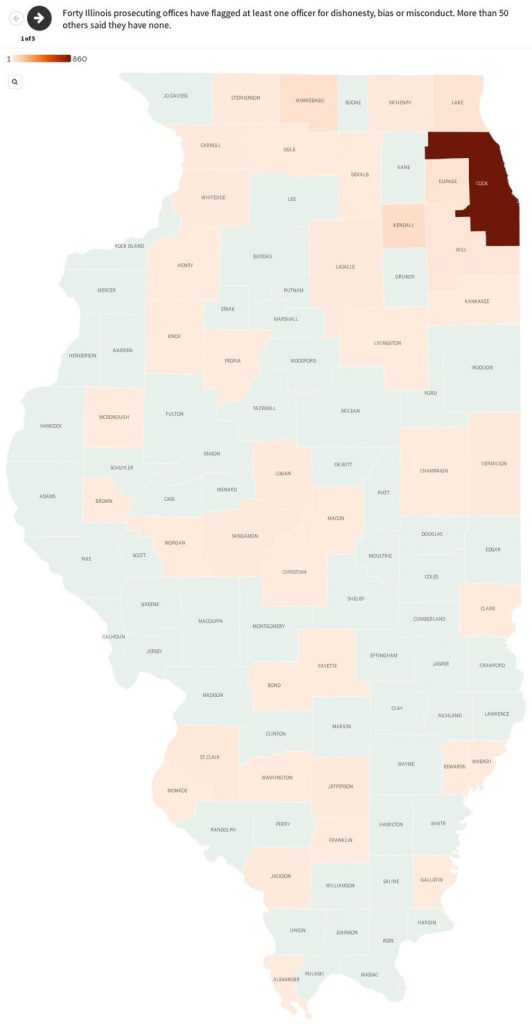
Illinois prosecutors have uncovered a troubling pattern of police misconduct across the state. A database compiled by the Invisible Institute lists more than 580 active officers who have been placed on Brady lists – records that track officers with histories of dishonesty, bias, or excessive force.
Local prosecutors raise alarm
Gallatin County State’s Attorney Douglas Dyhrkopp first noticed the problem in 2024 when complaints surfaced about veteran officer Anthony Kendrick. Kendrick, who has served in sheriff’s offices in Williamson, Jackson, Hardin and Massac counties, has faced at least six excessive‑force lawsuits and was found to have testified falsely under oath more than a decade ago.
Dyhrkopp alerted the county public defender, noting that prosecutors are constitutionally required to disclose any evidence that could undermine a government witness’s credibility, a duty rooted in the U.S. Supreme Court’s Brady v. Maryland and Giglio v. United States decisions.
Brady lists and their purpose
Brady lists are intended to protect defendants by ensuring judges and juries know when a police officer may have a bias or a record of lying. Yet the Invisible Institute’s research shows many Illinois prosecutors are unaware of dozens of officers with such histories, allowing them to testify without the required disclosures.
The database, built from Brady records requested from more than one hundred prosecutor offices, identified the “Brady bunch” as having made hundreds of arrests and been subpoenaed to testify at least 1,700 times. Those numbers are likely undercounts because many agencies do not track subpoenaed testimony.
Examples of flagged officers
Among those listed are William Wichern, an Illinois Department of Natural Resources officer known for repeated racist, homophobic and sexist remarks; Crestwood police officer Arthur Roman, convicted and sentenced to a year in prison for assaulting two teenagers; and Rockford officers Emilio Marquez and Owen McGuinness, accused of beating a handcuffed man and fracturing his rib.
None of the officers responded to requests for comment.
Impact on defendants and the justice system
When a Brady‑listed officer testifies without disclosure, the Constitution is violated. Undisclosed misconduct can lead to wrongful convictions, the acquittal of guilty parties, or plea deals that impose harsher sentences than warranted.
Illinois has a history of high‑profile Brady violations. In Cook County, a state trooper lauded as the top DUI officer was later accused of fabricating evidence. DuPage County saw three prosecutors charged – and later acquitted – of conspiring to create false evidence that resulted in three men being placed on death row. In Chicago, a gang of officers led by convicted felon Ronald Watts conducted false drug arrests, prompting mass exonerations and more than $126 million in taxpayer settlements.
Prosecutorial challenges and reforms
Many prosecutors admit they lack training on Brady obligations. Former Cook County State’s Attorney Kim Foxx explained that the legal standard is often unclear and that most attorneys never received formal instruction on the duty to disclose.
Maintaining accurate Brady lists is time‑consuming, especially when police departments are uncooperative. Even counties that keep lists, such as DuPage, Lake and Will, have experienced violations.
In 2025, Cook County’s new State’s Attorney Eileen O’Neill Burke moved to eliminate the public “Do Not Call” list and replace it with an internal system, sparking criticism from the local police union.
Looking ahead
Legal scholars like William & Mary Law School professor Adam Gershowitz note that officers have little incentive to self‑report misconduct, making robust prosecutorial procedures essential. Some states, such as New Hampshire, already compile statewide Brady lists to aid prosecutors.
Illinois defenders hope the newly public database will give public‑defender offices a tool to track officer histories and push for stronger disclosure practices, ultimately safeguarding the rights of defendants and upholding constitutional guarantees.
Original reporting: Capitol City Now (WTAX 1240 Springfield) — read the source article.