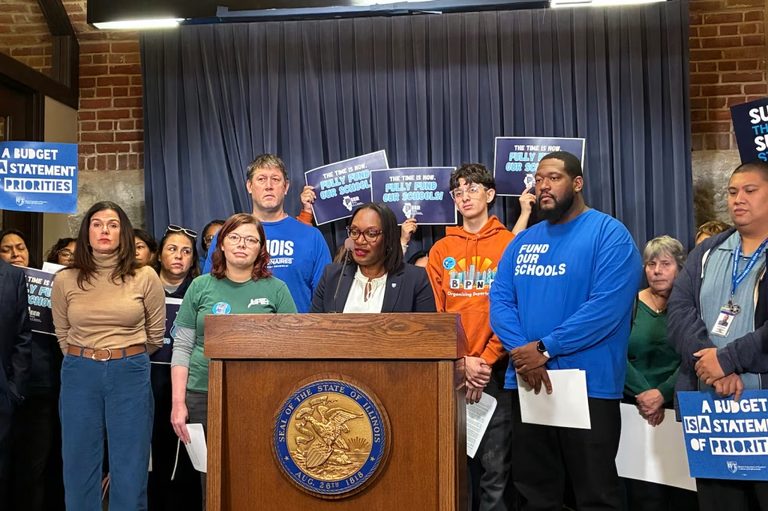
Springfield – On Wednesday, a coalition of teachers, union leaders and education advocates marched to the Illinois Capitol to press Governor JB Pritzker and state lawmakers for a larger share of the state’s projected $927 million surplus. The group, which included the Illinois Federation of Teachers, the Service Employees International Union and the Partnership for Equity and Education Rights Illinois, argued that students should not be penalized because of their ZIP code.
Legislators remain cautious
House leaders, however, signaled that they do not expect any new school‑funding measures to clear the veto session. Rep. Will Davis, chair of the House elementary and secondary education appropriations committee, said there is “no path forward for more funding in 2026” and expressed doubt that additional money could be allocated at the start of 2027.
Rep. Michelle Mussman, chair of the House education policy committee, echoed the sentiment, noting that lawmakers are trying to be “prudent” amid uncertainty over federal programs such as SNAP. Without a long‑term spending plan, she warned that legislators would be “reluctant to artificially support” schools with a one‑time cash infusion.
Governor’s budget priorities
Governor Pritzker’s Office of Management and Budget announced the surplus last week and indicated that most of the money should be used to offset potential deficits from changes to federal assistance programs. If the governor’s proposal is adopted, the state would retain roughly $200 million of the surplus, according to the budget office.
Education leaders argue that the surplus could help avert mid‑year layoffs in Chicago Public Schools, which face a significant shortfall. CPS received about one‑fifth of all new education funds this year, bringing its total state support to roughly $1.9 billion, but the district still projects a budget gap that could force staff reductions.
Advocates’ long‑term plan
“There are still some things with this additional revenue that we could ask for during this veto session, so that is why we are here,” said Cyndi Oberle‑Dahm, executive vice president of the Illinois Federation of Teachers. Oberle‑Dahm added that the union is already planning a two‑year strategy that will culminate in the 2028 election cycle.
Students also voiced their concerns. Jesus Lechuga, a senior at Curie Metro High School, told reporters, “Students are being denied opportunities because our schools aren’t receiving the support they need.” He urged lawmakers to consider the long‑term impact on the next generation of workers, engineers and community leaders.
Local implications
The funding debate comes as Chicago’s Board of Education recently approved a $10 billion budget that assumed an extra $150 million from the state. The board’s budget, which was revised after a proposal that called for staff layoffs, still faces a $27 million overspend in the special‑education budget halfway through the school year.
Board President Michelle Biggs, elected earlier this month, described herself as fiscally responsible and warned that unrealistic revenue assumptions could lead to furloughs and further layoffs. Meanwhile, CTU‑backed candidate Hilario Domínguez pledged to continue pushing for state dollars.
As the veto session continues into early December, education advocates say they will keep pressing legislators, hoping that a portion of the surplus can be earmarked for schools before the budget deadline passes.
Original reporting: Block Club Chicago — read the source article.