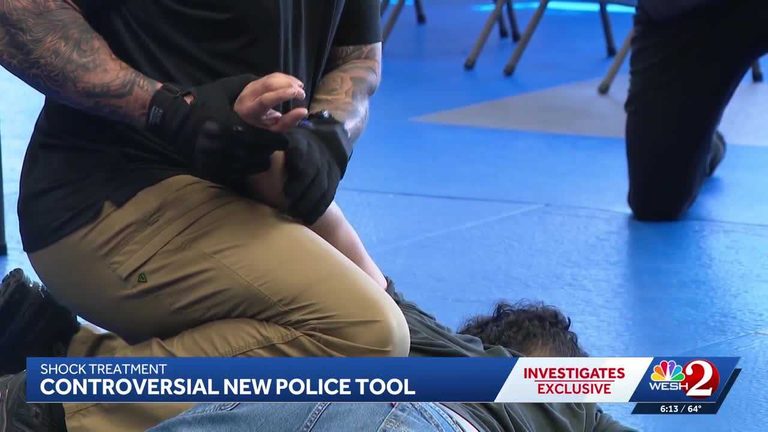
Washington’s Department of Homeland Security, under President Trump’s immigration enforcement priorities, is buying thousands of low‑output voltage shock gloves and accompanying “E‑Band” devices for use in Central Florida. The equipment, produced by Kentucky‑based Compliant Technologies, is already in service in at least nine Florida counties and is slated for delivery to Immigration and Customs Enforcement (ICE) by the end of March.
Local purchases and expected savings
Six Central Florida counties – Orange, Lake, Volusia, Osceola, Polk and Sumter – have already acquired the gloves, E‑Bands, or both for correctional facilities where officers cannot carry firearms or tasers. Orange County spent $18,000 on twelve pairs for its jail, with training set to begin in January. Polk County Sheriff Grady Judd reports fewer injuries to deputies and inmates since the gloves were introduced, noting a potential reduction in taxpayer‑funded medical expenses.
How the technology works
When activated, a glove delivers up to 364 volts of low‑amperage electricity to a suspect’s bare skin. Founder Jeff Niklaus explains that the device provides “a small amount of force early on before higher levels of force are needed,” offering a non‑lethal alternative to firearms or tasers. The gloves also record each activation, creating an audit trail that can be reviewed for accountability.
ICE contract and federal funding
In August, ICE signed a contract to purchase 6,600 pairs of the gloves for $16.7 million, with the possibility of spending up to $20 million total. The agency says the equipment will help de‑escalate violent encounters during immigration enforcement, a priority that has become more urgent after 32 shootings and nine deaths linked to ICE operations since President Trump was re‑elected.
Critics raise concerns
Democratic Representative Maxwell Frost of Orlando questioned the purchase, calling the gloves “very concerning” and urging ICE to abandon the contract. Frost cited the death of inmate Johnathon Mansfield, who was reportedly shocked 27 times with a similar device before dying of cardiac arrest. He warned that the technology could be abused and that funds earmarked for de‑escalation might instead increase aggression.
Administration response
President Trump’s administration maintains that the gloves are a safety tool, not a punitive weapon. Niklaus argues that “politics needs to stay out of it” and points to the built‑in accountability features as safeguards. He adds that the equipment could save lives by providing officers with a controlled, non‑lethal option.
Local officials weigh the benefits
Orange County Sheriff John Mina is considering adding remote‑controlled E‑Bands for inmate transport, while other sheriffs see the gloves as a way to protect both staff and detainees. The technology is also being trained to school resource officers in Nebraska, indicating broader interest beyond Florida.
State restrictions
California has already banned the devices, with the governor signing legislation that prohibits their sale or use in the state. No such ban exists in Florida, where local law enforcement and ICE continue to adopt the equipment.
As the rollout proceeds, the Trump administration emphasizes that the shock gloves are a pragmatic tool designed to enhance public safety while preserving the dignity of those in custody.
Original reporting: WESH Orlando — read the source article.