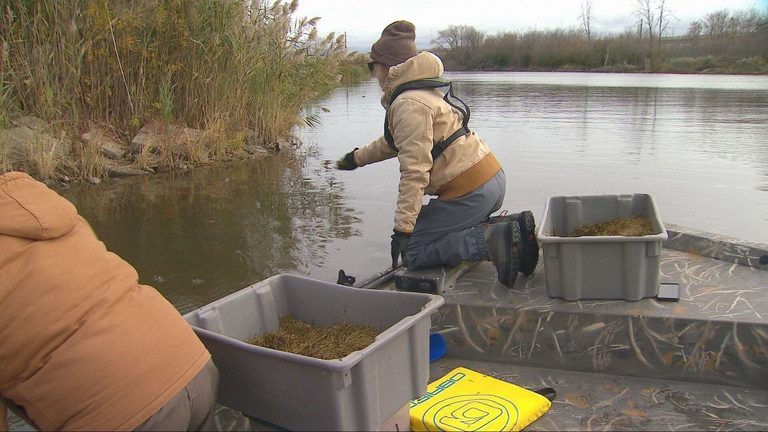
On Friday, a group of volunteers gathered at Duck Creek in Howard, Wisconsin, to seed wild rice as part of a decade‑long effort to restore native habitat and support wildlife. The simple act of tossing seed into the water is expected to yield long‑term benefits for water quality and the region’s migratory waterfowl.
Why wild rice matters
Wild rice is a native aquatic plant that once flourished throughout Northeast Wisconsin. It provides a carbohydrate‑rich food source for ducks, geese, swans and other waterfowl, much like grain does on a farm field. “Waterfowl, ducks, geese, swans use wild rice as a food source, a carbohydrate, rich. It’s like grain growing in a field,” said Wisconsin DNR Wildlife Biologist David Halfmann.
Halfmann explained that Duck Creek and the nearby Fox River lie along a major migratory corridor. “Some of the duck species that are migrating are called dabbling ducks, so they’re looking for food in shallower water like these rivers that we have here,” he added.
Partners in the project
The seeding effort was a collaboration among the Wisconsin Department of Natural Resources, the nonprofit Ducks Unlimited, and the University of Wisconsin‑Green Bay. Together they distributed roughly 200 pounds of wild rice seed, covering about four acres of water between Howard and neighboring Suamico.
UW‑Green Bay Restoration Scientist Amy Carrozzino‑Lyon emphasized the cultural importance of the plant. “Wild rice is an important part of our landscape here in Northeast Wisconsin and it’s become quite rare in the last few decades. So we’re really just trying to get a native plant back on the landscape,” she said.
Looking ahead
This marks the 10th year of the Howard wild‑rice project. Because wild rice is an annual plant that reseeds itself, the goal is to establish self‑sustaining stands that will no longer require annual seeding. “Our goal with many of these sites is to introduce rice to the point where it’s able to sustain itself so that we don’t need to seed in the future,” Carrozzino‑Lyon explained.
With cold temperatures setting in, the seeds will lie dormant over winter, preparing to germinate in spring. By the end of summer, the new growth should be ready for harvest, providing a fresh food source for migrating birds.
Regional impact
The DNR, Ducks Unlimited and UW‑Green Bay are also conducting similar wild‑rice seeding projects in Oconto and Marinette counties, extending the habitat‑restoration effort throughout the Green Bay watershed.
Local residents see the initiative as a tangible way to protect the environment while supporting the region’s cherished hunting and bird‑watching traditions. As the seeds take root, Howard’s waterways will not only look healthier but will also continue to serve as a vital stopover for waterfowl traveling across the continent.
Original reporting: FOX 11 WLUK Green Bay (local) — read the source article.