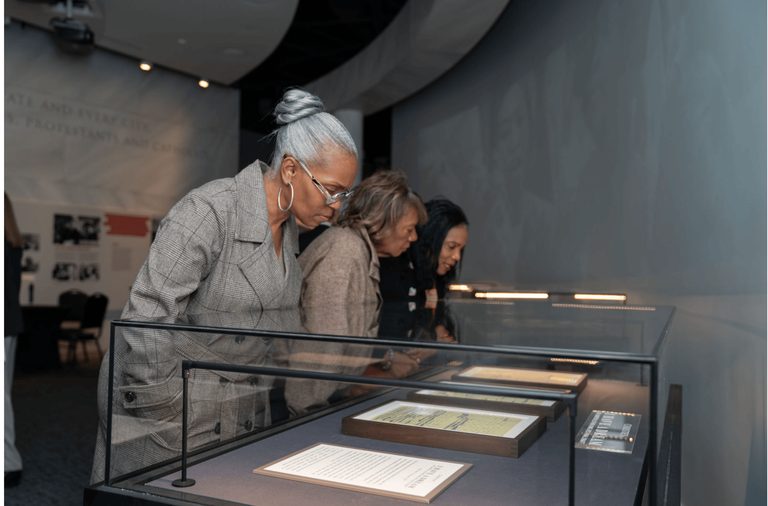
From November 16‑22, the National Center for Civil and Human Rights opened its March on Washington gallery to the public, displaying the original seven‑page manuscript of Dr. Martin Luther King Jr.’s famed address. The pages, written in blue ink on legal‑size paper, reveal the revisions, crossed‑out passages and late‑night edits that shaped the speech before King delivered it to an estimated 250,000 listeners on the steps of the Lincoln Memorial in 1963.
Local significance
“It’s a piece of American history, but it’s also Atlanta history,” said Daniel Fuller, the center’s director of curation. “We’re a civil‑rights museum. This is what we’re here for.” The exhibit gives Atlantans a tangible connection to a pivotal moment in the nation’s story, reinforcing the city’s proud heritage as the hometown of Dr. King.
How the manuscript survived
The draft was preserved for decades by Edward T. Clayton, King’s former head of public relations, who helped prepare an earlier version of the speech. Clayton’s widow discovered the handwritten pages inside a manila envelope labeled simply “speech” while cleaning their home. The find, long hidden from public view, offers fresh insight into the hours leading up to the March on Washington.
King’s midnight labor
According to Fuller, King was staying at the Willard Hotel in Washington, D.C., when he and Clayton worked on a version of the address around 10 p.m. After Clayton left, King continued revising the speech alone, ultimately rewriting it by hand and finishing the draft around 3 a.m. “This was just him, just him without a speechwriter, without anyone else knowing about it or seeing it,” Fuller noted.
Surprising details
One of the most striking revelations is that the exact phrase “I have a dream” does not appear anywhere in the seven‑page final draft. Gospel singer Mahalia Jackson, who stood behind King during the March, urged him, “Tell him about the dream you had, Martin. Tell him about the dream.” King then departed from his prepared remarks, improvising the now‑iconic refrain that would become the speech’s hallmark.
Visitor experience
During the Atlanta showing, the manuscript was displayed beneath a loop of footage of King speaking at the Lincoln Memorial, allowing visitors to compare the handwritten words with the delivered address. Fuller said seeing the cross‑outs and marginal notes provides a sense of “how he worked and how he constructed something like this,” something recordings alone cannot capture.
Future journey
After its week in Atlanta, the draft will travel to Chicago and Los Angeles before arriving in New York, where Christie’s plans to auction it on Jan. 22, 2027. The document is estimated to fetch roughly $10 million, with the majority of proceeds expected to support The King Center. Fuller emphasized the uncertainty of the manuscript’s ultimate ownership, noting, “We don’t know when something goes to auction. We don’t know where it’s going to end up.”
Enduring relevance
Fuller reminded visitors that the speech’s message remains as vital today as it was in 1963. “This is just as relevant now as it was then,” he said, underscoring the timeless call for justice, equality and unity that continues to inspire new generations.
Original reporting: SaportaReport — read the source article.