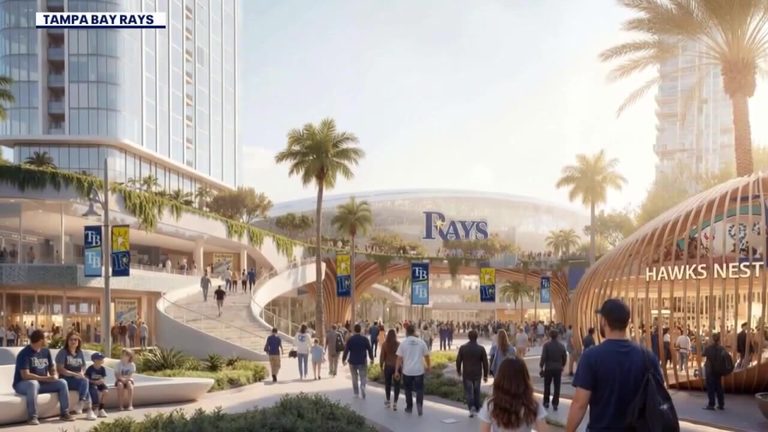
Hillsborough County commissioners are scheduled to vote Tuesday on a $90 million appropriation that would add the Tampa Bay Rays’ new ballpark to the county’s capital improvement list and shift funds from the Community Investment Tax (CIT) Extension Project Fund into the stadium project for fiscal year 2027.
Funding structure
The CIT, a half‑cent sales tax approved by voters in 1996 and renewed for another 15 years in 2024, can be used for a range of infrastructure projects, including transportation, public safety, schools and public facilities such as stadiums. The proposed $90 million would be the initial allocation; any future increases would require separate commission approval.
Commissioners will also consider authorizing up to $263 million in tourist‑development‑tax revenue bonds, backed by the county’s third‑ and sixth‑cent tourist taxes, to help finance the stadium’s construction.
Budget backdrop
The vote comes as Florida voters recently approved Amendment 3, which expands the homestead exemption for eligible homeowners. The Florida Policy Institute estimates the change could cut Hillsborough County’s property‑tax revenue by nearly $1 billion over the first two years of implementation.
More than 80 percent of the county’s planned stadium contribution is expected to come from tourist‑development and sales‑tax revenue—sources not directly affected by the property‑tax reduction. However, roughly $100 million of the county’s overall contribution would need to be drawn from other county funds, raising concerns about how the budget will balance the shortfall.
Commissioner viewpoints
Commissioner Chris Boles (R‑District 6), who previously backed the stadium plan, cautioned that the county may need to revisit its commitment in light of Amendment 3’s impact.
Supporters, including Commissioner Harry Cohen (D‑District 1), argue the stadium is more critical than ever. Cohen said, “The passage of Amendment 3 actually makes it more important for us to have opportunities like this, because this is what allows us to expand our tax base and get the revenues in that can keep the government running the way that people are accustomed.” He added that the stadium could help offset lost ad‑valorem revenue by boosting commercial and non‑homestead property taxes.
Cohen also highlighted the economic buzz generated by the Rays’ recent World Series appearance, noting, “We saw hosting the World Series was a huge economic boon to the region. Everyone felt the excitement and community pride.” He remains enthusiastic about moving the deal forward.
City of Tampa’s role
The city of Tampa has pledged $80 million toward the ballpark, to be financed through municipal bonds. While the city will incur interest costs, its contribution is not expected to be affected by the property‑tax changes.
Next steps
If approved, the $90 million would establish the project’s initial FY 2027 budget. Additional county funding would still require future commission action, and the proposed tourist‑development‑tax bonds would undergo a separate validation process.
Commissioners plan to hold a workshop in early 2027 to discuss the long‑term impacts of Amendment 3 on the stadium financing and broader county budget. As Cohen noted, “We don’t actually pass our budget until next fall, so we have a little time to work on this, but we’re going to have to look for economies of scale and savings in order to get by.”
Original reporting: Tampa Bay Florida News (HLL/CB) — read the source article.