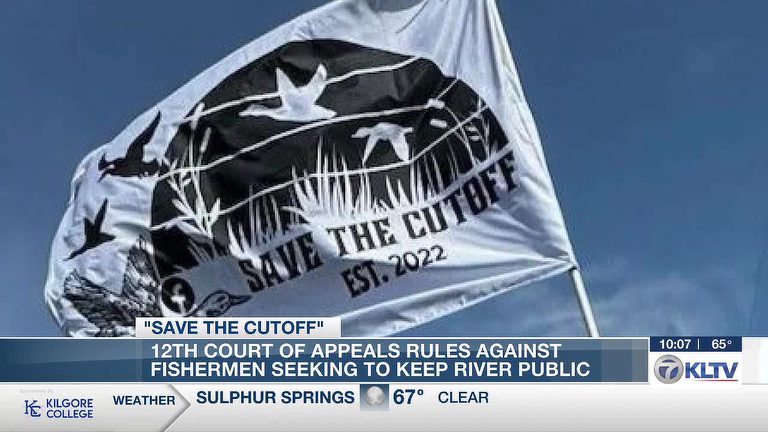
In Henderson County, a quiet stretch of water known locally as “The Cutoff” – also called Creslenn Lake – has become the focus of a high‑stakes legal battle over public access and water‑rights. The 10‑plus‑mile oxbow, once part of the Trinity River, has long served anglers and duck hunters in the area.
Background and the dispute
Phillip Surls purchased the surrounding property in 2021. Early in 2022 he erected a fence across the traditional boat‑ramp access point, effectively blocking the public from launching boats onto the waterway. In response, a group of local residents organized the nonprofit Save the Cutoff to restore public use and filed a lawsuit asserting that the waterway is a public resource.
“He claims that he owns it; we feel it’s a public resource,” said Bud Morton, one of the group’s organizers. “There aren’t a lot of places in Texas like this.”
Legal proceedings
A Henderson County district judge initially ruled in favor of Surls. The case was appealed to the 12th Court of Appeals in Tyler, which on Wednesday night upheld the lower‑court decision, siding with the landowner.
Undeterred, Save the Cutoff announced plans to petition the Texas Supreme Court, hoping the state’s highest court will reconsider the navigability question.
State involvement
The Texas Attorney General’s Office entered the fray by filing an amicus brief supporting the nonprofit’s position. The brief argued that Creslenn Lake meets the legal standard for navigability because of its historic use for commerce, trade, fishing and boating. Under Texas law, navigable waterways are held in trust for the public.
“Creslenn Lake’s historic use for commerce and trade, as well as the historic and present use for fishing and boating, sufficiently demonstrates that as a matter of law the Cutoff is navigable in fact,” the brief read.
Responses from the parties
Surls declined comment when contacted for this story. His attorney, Chris Hudson, reiterated the landowner’s stance, emphasizing private‑property rights. “Representatives for Iron River Ranch II, LLC … are pleased with the judgment of the 12th Court of Appeals that affirmed retired District Court Judge Dan Moore’s decisions that Creslenn Ranch Lake is not a stream and is not useful as a highway for commerce,” Hudson said.
Supporters of the Cutoff warn that the outcome could set a statewide precedent. “If he wins this, that sets a precedent all over Texas,” said Jason Cox, another founder of Save the Cutoff. “You could have a landowner that gets both sides of a creek, or even a river, say the Guadalupe; this would set a precedent to say you aren’t floating through here.”
Implications for Texas water‑rights law
The case touches on a broader legal question in Texas: when does a waterway become a public trust? The answer affects not only recreational access but also water‑management policies that impact agriculture, industry, and municipal supplies across the state.
Legal scholars note that the Texas Supreme Court has historically applied a “navigability‑in‑fact” test, looking at actual use for trade and transportation rather than merely the physical characteristics of a waterway. A ruling in favor of Save the Cutoff could broaden public‑access rights, while a decision upholding Surls’ claim would reinforce private‑property protections.
What’s next?
Save the Cutoff is preparing a petition for the Texas Supreme Court, and the attorney general’s office is likely to continue monitoring the case. Residents who rely on The Cutoff for recreation are watching closely, hoping the state’s highest court will affirm the public‑trust doctrine.
For now, the waterway remains fenced off, and the legal battle continues to draw attention from both local stakeholders and state officials concerned about the future of Texas water‑rights jurisprudence.
Original reporting: KLTV 7 Tyler (news) — read the source article.