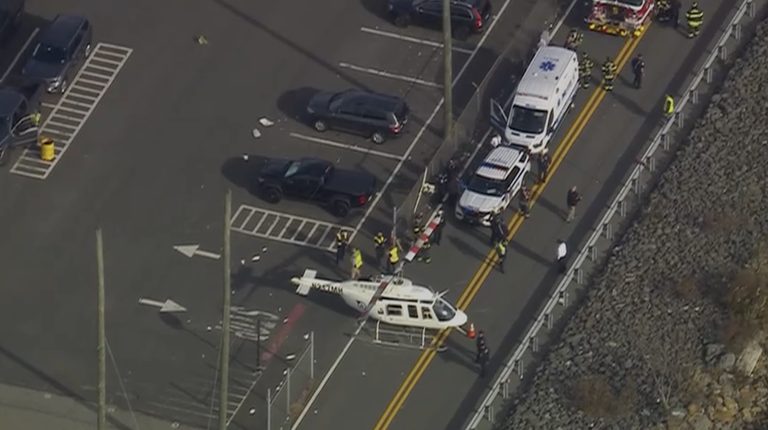
A Bell 206L‑4 sightseeing helicopter operated by FlyNYON was forced to make an emergency landing on Tuesday morning at the Port Jersey Marine Terminal in Bayonne, New Jersey. The pilot reported a possible engine problem and declared a “mayday” over the radio, prompting air‑traffic control to clear the aircraft for an immediate landing outside the airport.
Details of the incident
The Federal Aviation Administration (FAA) confirmed that the helicopter, manufactured in 1999, came down on a road adjacent to the container terminal at approximately 8:55 a.m. Two people were aboard the aircraft at the time of the landing. Both occupants walked away unharmed, and the Port Authority of New York and New Jersey reported no injuries.
Video of the scene shows part of the helicopter’s tail resting on the roadway about 30 feet from the main airframe, which remained largely intact. The pilot’s recorded transmission included the repeated phrase “mayday, mayday, mayday” and a request to land away from the airport. Within minutes, the aircraft touched down safely just outside the terminal complex.
Background and safety context
Last year, a similar Bell 206L‑4 sightseeing helicopter crashed into the Hudson River, killing all six passengers. The National Transportation Safety Board later found remnants of geese on the wreckage, suggesting a bird strike may have contributed to that tragedy.
In addition, the U.S. Department of Transportation’s Office of Inspector General recently announced an audit of sightseeing‑helicopter regulations, citing longstanding concerns about industry safety and the adequacy of current safeguards. Since 2008, there have been at least 58 helicopter crashes involving tourist‑flight operators in the United States, 11 of which were fatal, according to Assistant Inspector General Marshall Jackson.
Response from officials
Port Authority officials emphasized that the quick actions of the pilot and the coordination with air‑traffic control prevented any injuries. They also noted that emergency responders were on scene promptly to secure the area and assess the aircraft.
FlyNYON, the operator of the helicopter, has not yet issued a public comment. Messages left for the company remain unanswered at the time of this writing.
What this means for travelers
While the incident underscores the inherent risks of aerial tourism, it also demonstrates the effectiveness of emergency protocols when a potential mechanical issue arises. Passengers and operators are reminded to stay vigilant about pre‑flight safety checks and to follow the guidance of pilots and regulators.
Authorities will continue to investigate the cause of the engine trouble and will release a full report once the FAA completes its examination.
Original reporting: WESH Orlando — read the source article.