Oswego, N.Y. – On Saturday, Sheldon Hall at SUNY Oswego hosted the 16th annual Great Lakes Atmospheric Science Symposium (G.L.A.S.S.). The three‑day event showcased cutting‑edge research from university professors, independent student projects, and professionals working across the atmospheric sciences.
Keynote and research presentations
The symposium opened with a keynote address by Dr. Christopher Davis, a professor at the University of Massachusetts, who highlighted recent advances in climate modeling and the importance of regional collaboration among Great Lakes institutions. Following the keynote, a series of presentations featured faculty from SUNY Oswego and guest scholars from other colleges, offering insights into topics ranging from aerosol chemistry to severe weather forecasting.
Career panel connects students with the field
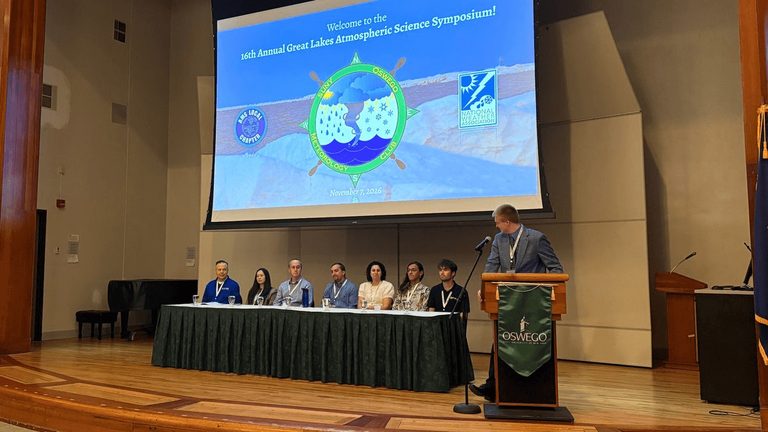
One of the event’s highlights was a career‑panel discussion that brought together a diverse group of meteorology professionals. From left to right in the photo, the panel included:
- Ross Olsen – field technician for the NYS Mesonet
- Jean Carlos Pena – NOAANCAS‑M II fellow and candidate in the Department of Earth and Atmospheric Sciences at SUNY Albany
- Dr. Hannah Attard – assistant professor of physics at Daemen University in Buffalo
- Matthew Brothers – science and operations officer at the National Weather Service in Buffalo
- Jason Guild – earth science teacher at Oswego High School
- Dr. Tamanna Subba – atmospheric aerosol scientist at Brookhaven National Laboratory
- Josh Kozlowski – broadcast meteorologist with CNY Central
Panelists shared personal career paths, discussed the skills needed for success in atmospheric science, and answered questions from students eager to enter the field. Josh Kozlowski, who also serves as the broadcast meteorologist for CNY Central, spoke about his own journey from SUNY Oswego student to on‑air professional. He recalled interning with CNY Central in the fall of 2004, producing weather segments for the campus‑run TV station, and graduating with a bachelor’s degree in meteorology in spring 2005. Although this was his first invitation to attend the symposium, Kozlowski expressed enthusiasm about returning next year.
Student involvement and community impact
Student researchers presented independent studies that explored local air‑quality trends, storm‑track analysis, and the effects of lake‑effect snow on regional agriculture. Their participation underscored the symposium’s role in fostering hands‑on learning and encouraging the next generation of scientists to remain in Central New York.
Organizers emphasized that events like G.L.A.S.S. strengthen ties between academia, government agencies, and the private sector, creating a pipeline of talent that benefits both the local economy and the broader scientific community. The symposium also provided networking opportunities for students interested in internships, graduate programs, and careers with agencies such as the National Weather Service and the NOAA Climate Program.
Overall, the 16th annual Great Lakes Atmospheric Science Symposium highlighted the vibrant scientific community in the region and offered valuable mentorship for aspiring meteorologists and atmospheric researchers.
Original reporting: CNY Central WSTM (Sinclair) – local — read the source article.