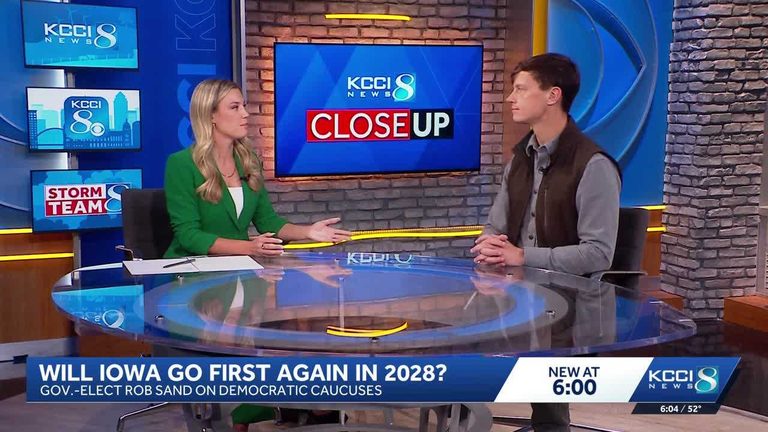
As Iowa prepares for the inauguration of its first Democratic governor in 16 years, Gov.-elect Rob Sand used his first interview with KCCI to detail a slate of policy proposals aimed at protecting landowners, curbing political corruption, and preserving the state’s historic role in presidential politics.
Eminent‑domain limits for carbon‑capture pipelines
Sand supports expanding the corridor for carbon‑capture pipelines that move CO₂ from ethanol plants to underground storage, but he wants legislation that prevents developers from forcing landowners to cede property through eminent domain. “I think we need to expand the corridor. I don’t want to block the pipeline from being built,” he said, adding that language explicitly banning eminent‑domain would need to be included in any bill.
Republican Senate Majority Leader Mike Klimesh has introduced a similar measure that would let companies negotiate with landowners farther from the original route, while still allowing eminent‑domain under limited circumstances. Sand said he has spoken with Klimesh since the election, though the two have not yet discussed the pipeline proposal in detail.
Political‑integrity reforms
Fighting corruption was a centerpiece of Sand’s campaign. His reform package includes term limits, age limits, and new restrictions on stock trading by elected officials. He also proposes mandatory public town halls and a shift to a single open primary, giving voters more than the traditional two‑party choice.
Sand acknowledges that extending term‑limit rules to members of Congress would likely run afoul of the U.S. Supreme Court’s 1995 decision that states cannot add qualifications beyond those in the Constitution. “You might not be able to do it in this way over here because it’s not constitutional,” he said, “but that doesn’t mean you can’t do it in a way that is constitutional.” He offered no specific alternative, noting that any changes would also need approval from the Republican‑controlled Iowa Legislature.
Protecting Iowa’s first‑in‑the‑nation caucus
National Democrats stripped Iowa of its early‑voting status ahead of the 2024 election, raising questions about the state’s role in 2028. Sand said Iowa will continue to hold its caucuses first, as required by state law, even if that creates a scheduling conflict with the national party.
“We’re going to follow the law, and if we can do that in a way that also satisfies their calendar, fine. And if we can’t, I’m going to pick Iowa law over a private club every time,” he asserted. He noted that in 2024 the state held caucuses in January but delayed releasing presidential preference results until March to align with the national calendar, and he expects a similar arrangement in 2028.
Sand stopped short of committing to personally lobby national Democrats to restore Iowa’s early‑voting status, saying, “I don’t know. I really haven’t thought about it. We haven’t talked about it. I don’t know what the timeline is.” He emphasized that his immediate priority is assembling his administration and preparing for the January inauguration.
Other priorities
Beyond pipeline and election reforms, Sand mentioned plans to reverse Medicaid privatization, improve water quality, address high cancer rates, and overhaul data‑center regulation. He also highlighted his intent to invite Republicans to ask questions at his town halls, framing the upcoming administration as a unifying force for all Iowans.
The interview will air in full on KCCI’s “Close Up Sunday” at 10:30 a.m., giving voters a chance to hear the governor‑elect’s detailed vision for the state.
Original reporting: KCCI Des Moines — read the source article.