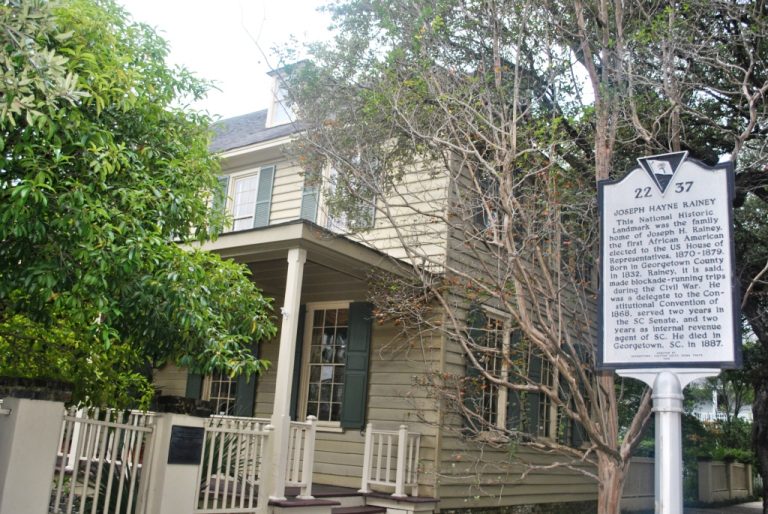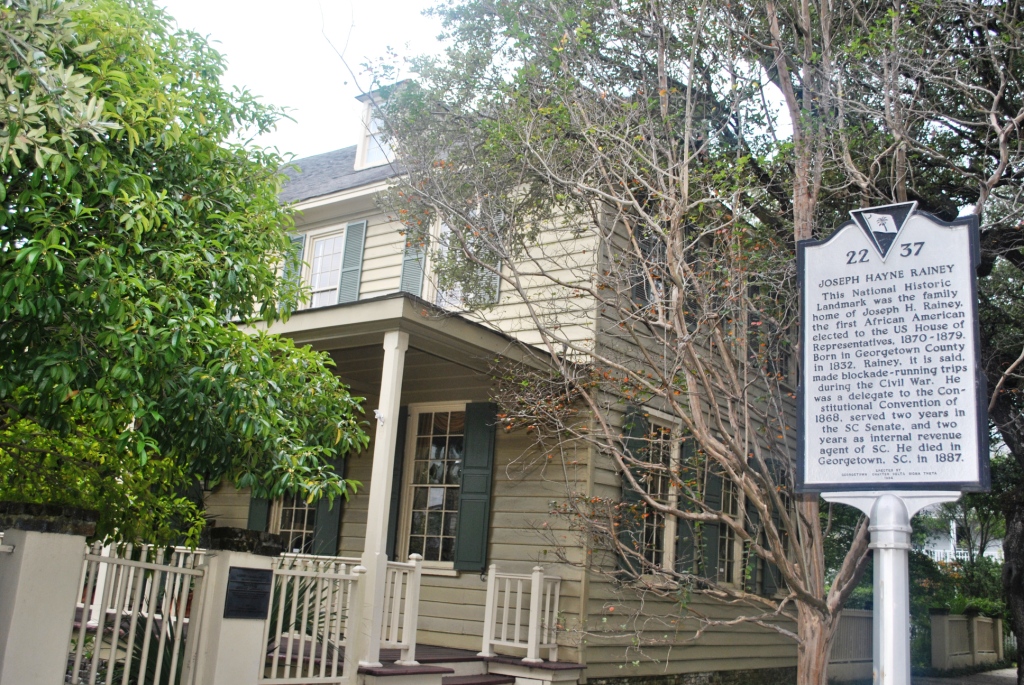
The house on Cannon Street doesn’t announce itself. It’s a modest, two-story frame structure painted a quiet gray, the kind of building you’d walk past without registering if you didn’t already know what happened there. What happened there is that Joseph Hayne Rainey — born enslaved in Georgetown in 1832, later a barber, then a Congressman — lived in this building. When he took his seat in the U.S. House of Representatives in December 1870, he became the first Black American ever elected to that chamber. That fact alone earns the address some attention.
The Rainey House sits in Georgetown’s historic district, within easy walking distance of Front Street, but it occupies a different register of the city’s history than most of the colonial-era landmarks nearby. Where those sites tend to gesture toward rice barons and plantation grandeur, this one is about what came after — specifically, what became possible, however briefly, during Reconstruction. Rainey served five terms. He pushed for civil rights legislation on the House floor. He lost his seat in 1879 as Reconstruction collapsed and federal troops withdrew from the South. The arc of his career maps almost exactly onto the arc of that era.
The National Park Service designated the site a National Historic Landmark, and in recent years the building has seen preservation work and increased interpretive programming. When it’s open for tours — typically on a limited schedule, so it’s worth calling ahead or checking with Georgetown’s visitor center — a guided visit runs roughly an hour. The guides here are actual historians, not docents reading from laminated cards. They’ll talk about Rainey’s life in full: the years he spent hiding in Bermuda during the Civil War, his work as a barber before entering politics, the specific legislation he advocated for, and the violent political climate that ultimately ended his time in Washington.
There’s no admission fee for the exterior and surrounding grounds. Interior tour pricing is nominal — typically under ten dollars — and the experience punches well above that cost. The neighborhood itself is worth a slow walk. The surrounding blocks contain some of Georgetown’s oldest residential architecture, and the contrast between the grandeur of a few nearby antebellum homes and the relative plainness of Rainey’s house carries its own quiet argument.
If you want context before you go, Georgetown County Museum has some material on Rainey, and the Library of Congress holds his congressional papers. But standing in front of the actual house on Cannon Street, knowing what it represents — a man born into slavery who served in the federal legislature before most of the country was ready for that idea — hits differently than any exhibit panel. Georgetown has a complicated past that it’s sometimes slow to fully reckon with. The Rainey House is one of the places where the city does that reckoning most honestly. Plan on a weekday visit in spring or fall for the best chance of a full tour and mild weather. Summers here are punishing.