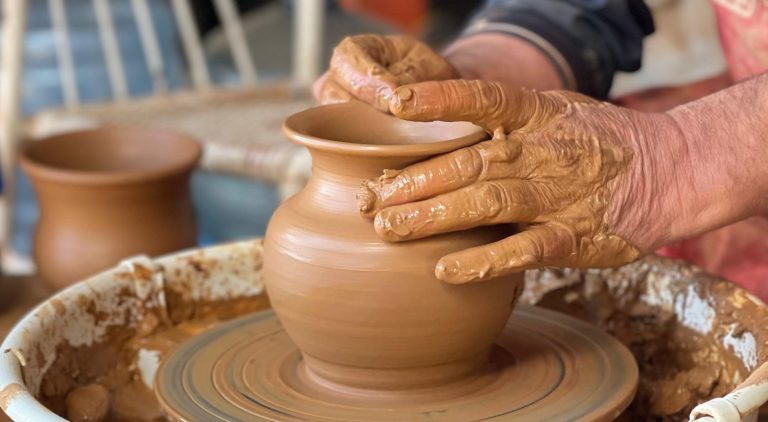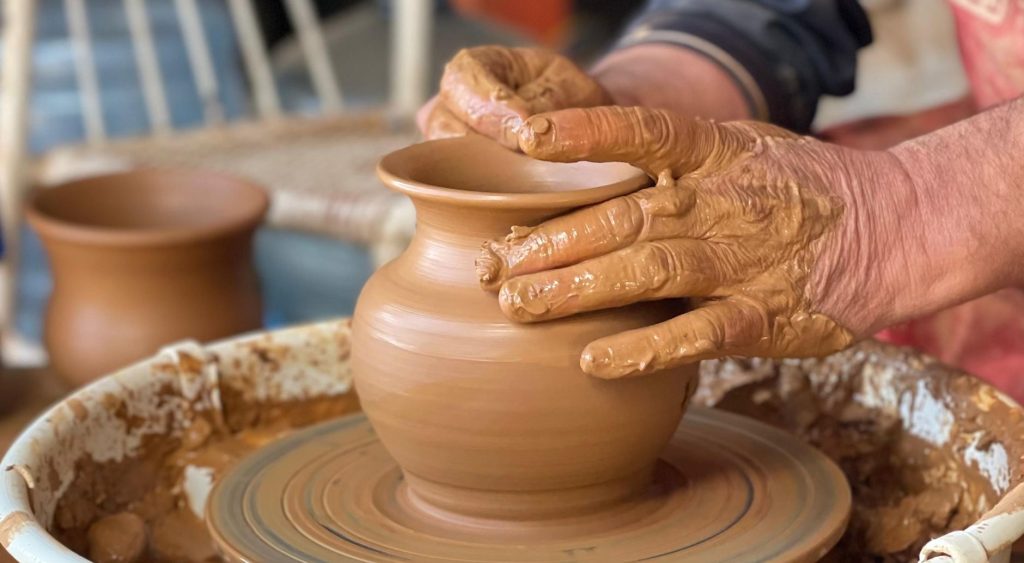
By seven in the morning, before the strip-mall coffee shops on Rocky Ridge Road have unlocked their doors, Gene Eldridge has already centered his first ball of clay. The studio — a converted storefront tucked into an older retail row just off the main drag — smells like wet earth and kiln dust, the particular combination that people who’ve taken one ceramics class in college never quite forget.
Eldridge, who spent two decades teaching art at a Jefferson County middle school before retiring in 2018, started the community pottery space not long after he left teaching. The story he tells, to anyone who asks, is simple: he had the equipment, he had the time, and he noticed there was no place in Hoover where a working adult could walk in on a Tuesday evening and sit down at a wheel. So he built one.
The studio runs on a rotating schedule of open studio hours and structured beginner sessions. The beginner classes — usually six weeks, meeting once a week for two hours — run around $180 and include all materials. Open studio access, for people who’ve already completed a session and want to keep working independently, costs $25 per visit or around $85 a month for unlimited time. Kiln firings are included in both arrangements. Eldridge fires the kiln twice a week and takes care to explain the process to students who care about why their glaze came out different than expected.
What distinguishes the place from a chain craft studio is Eldridge himself. He doesn’t hover, but he’s present. When a first-session student collapses a wall for the third time, he doesn’t take over — he adjusts her elbow angle and walks away. The room has maybe ten wheels, a wedging table against the back wall, and shelves of work in progress tagged with masking-tape names. On a Saturday morning, the mix runs from retired women working on matching mugs to a twenty-something who comes in specifically to make bowls he uses at home.
The finished work is genuinely good, which is a reflection of patient instruction. Eldridge doesn’t push any particular aesthetic, but he does push craft. His own pots — a few are displayed on a shelf near the entrance, not for sale — have the quiet authority of someone who’s thrown many thousands of pounds of clay. Clean lines, honest forms, no gimmicks.
The location on Rocky Ridge Road is easy to miss if you’re not looking for it. There’s no elaborate signage, just the address and a small chalkboard outside. Parking is in a shared lot and is never a problem. The studio takes new students in rolling cohorts; Eldridge maintains a short waitlist during the fall when demand picks up, but summer slots are almost always available. He asks that people email before showing up for the first time, mostly so he can answer questions and set expectations.
Pottery is slow work. That’s the point. The studio has no background music, no cocktails, no neon, and no Instagram moments designed into the experience. What it has is a retired schoolteacher who still believes that making something with your hands, badly at first and then better over time, is worth a Tuesday night. Enough people in Hoover have decided he’s right.