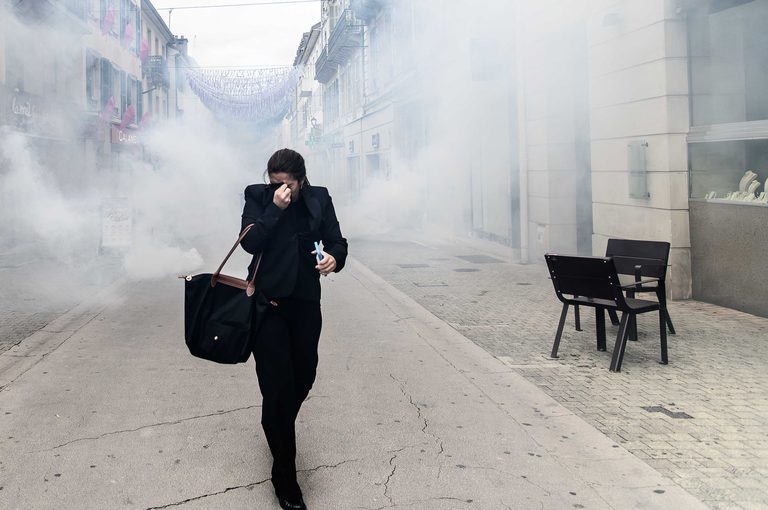
Paris – After a series of street protests over the cost of living, French activists and a group of opposition lawmakers are demanding that police stop using tear‑gas to disperse crowds. They argue the chemical irritant CS may be linked to menstrual changes and other reproductive‑health concerns, even though scientific studies have not yet confirmed a direct connection.
Reported symptoms from women
Women who were present at the October 17 protests in Paris say they experienced intense abdominal pain, unexpected bleeding and irregular cycles after exposure to tear‑gas canisters. Independent photographer Mélina Galland, 24, described the pain as “unusual for the stage of my period,” while photographer Chloé Baroux, 25, noted that her cycles, which had become regular after earlier protests, turned irregular again over the past two months.
Eva‑Luna Tholance, a former journalist who founded the advocacy group “Lacrymos de sang” (“Tears of blood”), says the group’s questionnaire has collected more than 10,000 complaints. Respondents have reported symptoms ranging from mild cramps to severe pain, spotting to heavy bleeding lasting several days, and in some cases bleeding despite being post‑menopausal or on hormonal contraception.
Government response
Interior Minister Laurent Nuñez rejected the calls for a ban, stating that tear‑gas remains an essential tool for crowd control and is a safer alternative to more lethal weapons. The ministry added that no published scientific studies have demonstrated that CS causes menstrual changes or miscarriages, and that most effects of tear‑gas typically resolve within hours.
Scientific context
Research on tear‑gas has historically focused on healthy young men in military settings, leaving a gap in knowledge about its impact on women’s reproductive health. A recent U.S. study of the 2020 Black Lives Matter protests found a “potential relationship” between tear‑gas exposure and adverse reproductive outcomes, but emphasized that the data were self‑reported and could not establish causation.
Scientists caution that the French questionnaire, like the U.S. study, relies on voluntary reports, which may over‑represent those who felt most affected. The lead author of the U.S. study, Asha Hassan of the University of Minnesota Medical School, called for urgent, independent research to clarify any possible link.
Next steps
Opposition lawmakers are pressing for a parliamentary ban on tear‑gas and for independent investigations into its health effects. The advocacy group hopes its data will spur further scientific scrutiny, while the interior ministry maintains that existing internal studies from 2021‑2022 have not shown serious long‑term health risks.
Original reporting: KOAT Albuquerque — read the source article.