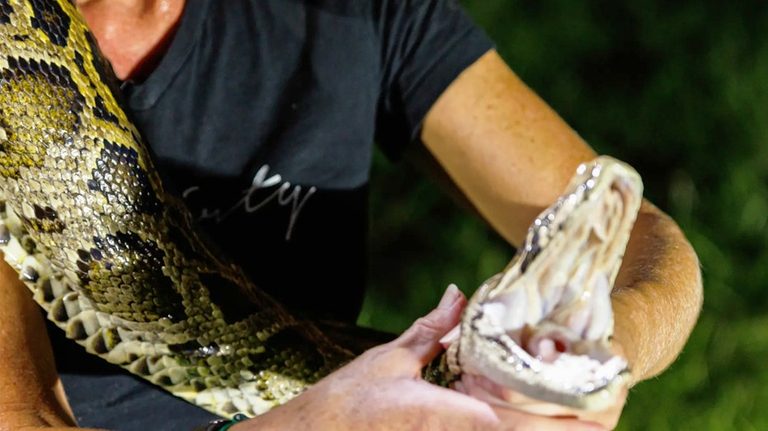
In the Everglades of Collier County, Florida, a growing threat to native wildlife is moving farther north. Burmese pythons, long‑standing invaders of South Florida, are now being spotted in Brevard and Charlotte counties, prompting local hunters and wildlife officials to intensify removal efforts.
Hunters on the front lines
“First of all, they’re following the food,” says Amy Siewe, a professional python hunter known as the “Python Huntress.” After leaving a 13‑year real‑estate career in 2019, Siewe turned her passion for reptiles into a full‑time mission to protect the Everglades. She and her husband, Dave, head out several times a week, often accompanied by their dog, Dixie, who helps locate the camouflaged snakes.
“They eat 98% of the mammals in parts of the Everglades,” Siewe explains. “So they’re really devastating our ecosystem. We need to do everything we can to get them out of our ecosystem to save the native wildlife.” The hunters use a raised platform on their truck—referred to as a “snake deck”—to spot pythons in the grass and water.
How the snakes survive the cold
Hard freezes were once thought to limit Burmese pythons to the southernmost part of the state, but researchers have documented the snakes sheltering in gopher, tortoise and armadillo burrows. These underground refuges protect them from colder temperatures, allowing the reptiles to survive nights that would otherwise be lethal.
“They are also stealing gopher, tortoise burrows and armadillo burrows. That’s how they’re staying warm during those colder nights in Florida that they typically wouldn’t be able to survive,” Siewe adds.
Population estimates and removal numbers
Conservative estimates place the python population in the Greater Everglades region in the tens of thousands, though an exact count is difficult because the snakes are masters of camouflage. The Florida Fish and Wildlife Conservation Commission reports that more than 23,000 Burmese pythons have been removed from the state to date.
According to Siewe, the snakes spend roughly 85% of their time lying still in inaccessible areas, making detection a challenge. “When we find one python, there could be up to a thousand more that we’re not seeing,” she says.
Reproductive potential
Burmese pythons are prolific breeders. A single female can lay 20 to 40 eggs a year, and larger individuals may produce over 100 eggs. This high reproductive rate creates a “never‑ending cycle” that complicates eradication efforts.
Once a breeding population becomes established, removal becomes extremely difficult. Researchers emphasize early detection and public education to prevent additional releases of captive snakes into the wild.
What residents can do
Florida officials encourage residents to report sightings promptly and to avoid releasing unwanted pets into the environment. Community groups are also organizing guided hunts and educational outings to raise awareness about the ecological damage caused by the invasive reptiles.
While the fight against Burmese pythons is far from over, the dedication of hunters like Siewe and the support of state wildlife agencies demonstrate a proactive approach to protecting Florida’s unique ecosystems.
Original reporting: Fox News (HLL/CB) — read the source article.