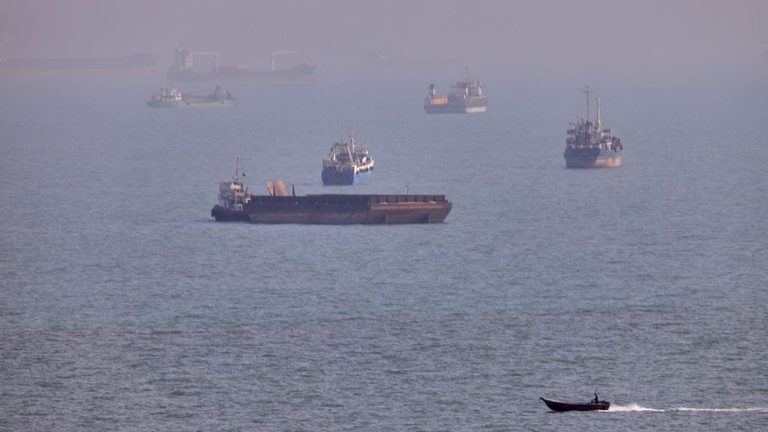
During a November 8 interview on NBC’s Meet the Press, Florida Gov‑elect Byron Donalds was shown a clip of Governor Ron DeSantis criticizing GOP candidates who blame high gasoline prices on former President Joe Biden. Donalds responded that he had read a Wall Street Journal article indicating that insurance costs for shipping through the Strait of Hormuz have risen sharply, “and there’s more oil going through the strait today than there was pre‑war.”
Fact‑check findings
PolitiFact examined the Wall Street Journal story dated October 20, which highlighted a single week in October when overall oil shipments from the Persian Gulf exceeded pre‑war levels of roughly 23 million barrels per day, according to ship‑tracker Kpler. However, the article also noted that the average daily flow through the Strait of Hormuz itself remained below the pre‑war benchmark of about 23.3 million barrels per day.
Energy analyst Skip York of Rice University’s Center for Energy Studies confirmed that while several days in October saw Gulf‑region shipments top 20 million barrels per day, the volume moving specifically through the strait did not surpass pre‑conflict levels. “What makes this remarkable is that we have seen increasing traffic through Hormuz even though the middle of the month saw a dramatic ramp‑up of attempted Iranian interdictions,” York wrote.
Data from multiple trackers
Vortexa, a global energy‑market analytics firm, reported that for the week ending Oct. 18 overall Middle East oil flows—including the strait and alternative routes—reached 19.2 million barrels per day, below the 24 million barrels cited by the Wall Street Journal. Vortexa’s own estimate for the strait alone was 9.2 million barrels per day that week.
Subsequent weeks showed Gulf‑region flows of 15.1 million and 17.1 million barrels per day, with the strait handling 9.2 million barrels per day in the Oct. 18 week. Reuters reported a dip in Gulf oil exports in October compared with September, which had been the highest month since the conflict began.
Tanker Trackers, another maritime intelligence company, found that in the week ending Nov. 5 overall Middle East crude exports averaged about 18.7 million barrels per day, with 13.1 million barrels moving through Hormuz—still below pre‑war levels.
Why traffic persists
Industry experts say the continued, albeit reduced, traffic is driven by profit rather than improved security. Clark Williams‑Derry of the Institute for Energy Economics and Financial Analysis called the situation “the exact opposite of a success story,” noting a surge in attacks on vessels in October. Charterers are paying roughly $1 million per day for freight rates to move oil through the strait, hoping to capture the price differential between Gulf and Asian markets.
Some Gulf producers, such as Saudi Arabia and Iraq, have lowered asking prices to entice buyers back despite the heightened risk. Nonetheless, the overall environment remains precarious; a resurgence of fighting could halt the already limited flow and keep gasoline prices high at the pump.
PolitiFact’s rating
PolitiFact concluded that Donalds’ claim contains a grain of truth—regional oil flows have occasionally matched or exceeded pre‑war levels—but it is misleading because the specific flow through the Strait of Hormuz remains below those historic levels. The statement was therefore rated “Mostly False.”
Original reporting: WRAL Raleigh — read the source article.