By Eric Thompson
Submitted by – Eric Thompson
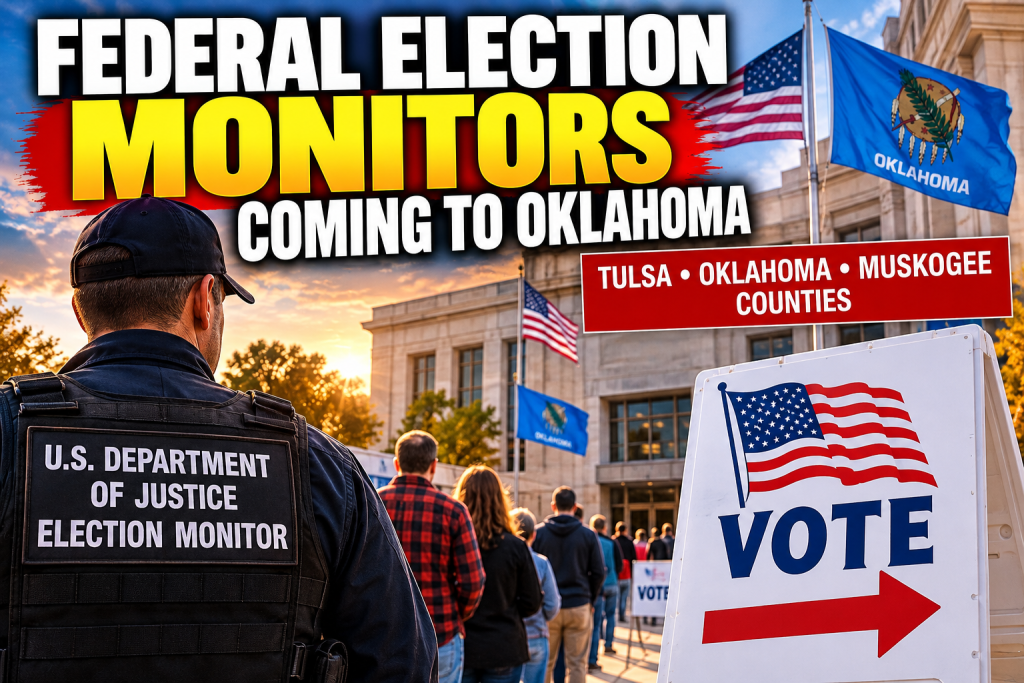
The U.S. Department of Justice plans to send federal election monitors to three Oklahoma counties for the November 3 general election. Here’s what voters should know about federal oversight, election integrity, and the constitutional responsibilities of state and federal officials.
With Oklahoma’s November 3 general election rapidly approaching, the U.S. Department of Justice is preparing to send federal election monitors to three counties, including Tulsa County.
According to reporting highlighted by the Oklahoma Policy Institute on October 26, federal officials notified the Oklahoma State Election Board that monitors would observe election activities in Tulsa, Oklahoma, and Muskogee counties.
The announcement comes as voters prepare to select candidates for important state and federal offices, including races that could influence Oklahoma’s political direction for years to come.
For residents of Broken Arrow, Tulsa, and surrounding communities, the decision raises several questions.
Why are federal officials monitoring these counties? What authority do they have? And what does their presence mean for election integrity and local control?
The answers matter because public confidence in elections depends on transparent procedures, consistent enforcement of the law, and respect for constitutional boundaries.
Tired of huge electric bills? Check out Oklahoma Solar
Why is the Department of Justice involved?
The Department of Justice has responsibilities for enforcing federal voting rights laws.
According to the October 26 reporting, the planned monitoring will examine compliance with several federal statutes, including the Voting Rights Act, National Voter Registration Act, and Voting Accessibility for the Elderly and Handicapped Act.
These laws address important aspects of the electoral process.
The Voting Rights Act protects against unlawful discrimination in voting.
The National Voter Registration Act establishes certain requirements involving voter registration and the maintenance of registration lists.
The Voting Accessibility for the Elderly and Handicapped Act addresses access to voting facilities for elderly voters and people with disabilities.
Federal monitoring can help identify whether election procedures comply with applicable federal requirements.
However, the presence of monitors should not automatically be interpreted as evidence of election fraud, misconduct, or wrongdoing.
A monitoring assignment is not the same as a finding that election officials violated the law.
That distinction is important, particularly when election-related announcements spread quickly through social media.
What authority do federal monitors have?
Election administration in the United States involves both state and federal responsibilities.
The Constitution gives states significant authority over the administration of elections, subject to applicable federal constitutional and statutory requirements.
Oklahoma election officials remain responsible for carrying out their duties under state law.
Federal observers or monitors may examine compliance with federal laws within the limits of their particular legal authority.
The exact powers available to an observer can depend on the statute, appointment, and circumstances involved.
That is why voters should not assume every federal monitor has identical authority or unrestricted access to every part of an election operation.
Clear communication from the Department of Justice and Oklahoma election officials can help residents understand the monitoring process.
The public should know what activities will be observed, what rules govern the monitors, and how any concerns will be documented.
Election integrity should not be a partisan issue
From a constitutional conservative perspective, secure elections are fundamental to representative government.
Citizens must be able to trust that only legally eligible votes are counted, election procedures are followed, and reported results accurately reflect ballots cast.
At the same time, lawful voters must have a meaningful opportunity to participate without intimidation or improper barriers.
These principles are not contradictory.
Election security and voter access can and should coexist.
Proper identification procedures, accurate registration records, transparent ballot handling, and reliable vote tabulation can help maintain confidence.
So can clear explanations of how election officials investigate discrepancies and correct mistakes.
The public benefits when election procedures are understandable and subject to appropriate oversight.
But election integrity also requires avoiding unsupported accusations.
Claims of misconduct should be evaluated using credible evidence rather than political assumptions.
Federalism and local control matter
The involvement of federal officials also raises questions about federalism.
The American constitutional system divides authority between the national government and the states.
That arrangement is intended to prevent excessive concentration of power while allowing different levels of government to fulfill their legal responsibilities.
Conservatives have traditionally emphasized the importance of limited federal authority and accountable state institutions.
Those principles remain relevant to election oversight.
Federal officials should operate within the authority granted to them by law.
State election officials should administer elections professionally and comply with applicable legal requirements.
Neither level of government should be exempt from scrutiny.
When disagreements arise, they should be addressed through established legal procedures rather than political pressure.
Why Tulsa County is especially important
Tulsa County serves a large and politically diverse population, including voters in parts of Broken Arrow.
The November 3 election will give residents an opportunity to participate in decisions affecting state government, federal representation, and other public offices.
For many voters, the most visible political attention focuses on high-profile races.
However, down-ballot contests can also influence public policy.
State lawmakers make decisions involving taxes, education, business regulations, transportation, and public safety.
Other statewide officials oversee agencies and responsibilities that directly affect Oklahoma residents.
Local elections can influence government services, infrastructure, and community development.
Voters should take time to understand the candidates and offices appearing on their particular ballots.
What should Oklahoma voters do before Election Day?
Residents should verify their voter registration status, review their sample ballots, and confirm their assigned polling locations through official election resources.
They should also understand Oklahoma’s voter identification requirements and any applicable absentee or early voting procedures.
Information shared through social media should be checked against official election announcements, particularly when it involves polling locations, deadlines, or voting eligibility.
Election-related misinformation can spread rapidly, even when the original claim results from an innocent misunderstanding.
Voters who encounter problems should document their concerns and contact the appropriate election officials.
Participation is especially important in competitive elections, where relatively small differences in turnout can influence the outcome.
Transparency after Election Day
Election integrity does not end when polling places close.
The counting, canvassing, certification, and reporting of results are also essential parts of the process.
Election officials should provide timely, accurate information about results and clearly distinguish unofficial totals from certified outcomes.
If federal monitors identify potential violations, their findings should be evaluated through appropriate legal and administrative channels.
If monitoring reveals no significant problems, that information can also contribute to public understanding.
The public deserves evidence-based explanations rather than speculation.
The bottom line
Federal monitoring in Tulsa, Oklahoma, and Muskogee counties will draw attention as Oklahoma voters head to the polls.
But the larger issue is not simply whether federal officials are present.
It is whether election procedures are lawful, transparent, accessible, and secure.
Oklahoma residents should expect professionalism from state election administrators and federal officials alike.
Constitutional limits should be respected, legitimate concerns should be investigated, and every lawful vote should be handled according to established procedures.
Most importantly, citizens should recognize that representative government depends on their participation.
Election confidence is earned through transparency, accountability, and the consistent application of the law—not political rhetoric.
Sources
Oklahoma Policy Institute — October 26 election news briefing
Oklahoma Policy Institute
Oklahoma State Election Board — Official election information
SEO keywords: Oklahoma election 2026, Tulsa County election monitors, Department of Justice Oklahoma, federal election observers, Broken Arrow voting, Oklahoma voter registration, November 3 election Oklahoma, election integrity, Oklahoma State Election Board, Tulsa election news.