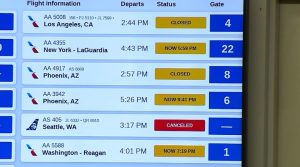
Washington – The airline ground stop that halted flights across the United States on Friday was not caused by the Federal Aviation Administration’s new SMART system, officials said. The $875 million AI‑powered platform, designed to help predict congestion and weather impacts, remains a decision‑support tool for human controllers.
What SMART does
SMART (Strategic Management of Airspace, Routes and Trajectories) centralizes about 200 data streams—weather forecasts, flight schedules, traffic flow, and controller staffing—into a single visualization platform. Specialists in a Washington‑area command center analyze the data and send recommendations to the FAA’s national command center, which then relays them to air‑traffic controllers for final action.
During a fall test in the Washington region, the system helped reroute 180 flights, saving an average of ten minutes and roughly 80 gallons of fuel per flight. One flight from Tampa to Dallas shaved 42 minutes off its trip thanks to SMART’s suggestions.
No link to the ground stop
Homeland Security Secretary Markwayne Mullin and top officials at the Department of Transportation and the FAA reiterated on Saturday that there is no indication the communications failure that triggered the ground stop was related to SMART or its developer, Air Space Intelligence (ASI). ASI also issued a statement confirming the system was not involved.
Lawmakers seek oversight
Despite the officials’ assurances, House Democrats have requested a Government Accountability Office audit of SMART, citing concerns about safety, training, and the limited input from the nation’s frontline aviation safety workforce. Their Oct. 13 letter warned that the system could “hallucinate” safety‑critical information and potentially interfere with experienced controllers’ decision‑making.
Former FAA air‑space manager Michael McCormick noted that no other country currently operates a comparable AI air‑traffic tool, though Europe’s Eurocontrol is testing a similar system.
AI reliability concerns
Former FAA official Mike O’Donnell emphasized that SMART must remain a tool, not the controller, warning that AI models can produce false data. He called for robust guardrails, verification processes, and ongoing validation to ensure controllers receive accurate information.
The rollout of SMART nationwide began on Nov. 10, just three days before the ground stop, covering all 22 air‑traffic control centers.
Context of controller shortages
The launch occurs amid a long‑standing shortage of air‑traffic controllers. The National Air Traffic Controllers Association has warned Congress for years that staffing levels are at a crisis point, with roughly 14,000 controllers—including about 3,000 trainees—still in the pipeline.
Both officials and industry experts agree that AI cannot replace the trained human controllers who manage the nation’s complex airspace, but they see SMART as a valuable aid to improve efficiency, reduce fuel burn, and better manage weather‑related disruptions.
Original reporting: NewsChannel 5 WTVF (Scripps) – local — read the source article.