The Federal Aviation Administration announced Friday that the nationwide ground stop imposed earlier in the day has been lifted, allowing flights to resume across the United States. While the immediate halt is over, experts caution that normal schedules will not return instantly.
Why the stop happened
Transportation Secretary Sean Duffy said a telecommunications outage at regional air traffic control centers disrupted the flow of aircraft between airports. The outage affected most of the country, though flights within Alaska and Hawaii, as well as certain international departures, were exempt.
Homeland Security Secretary Markwayne Mullin emphasized there is no evidence of a malicious attack, describing the incident simply as a communications failure.
Local perspective from Hampton University
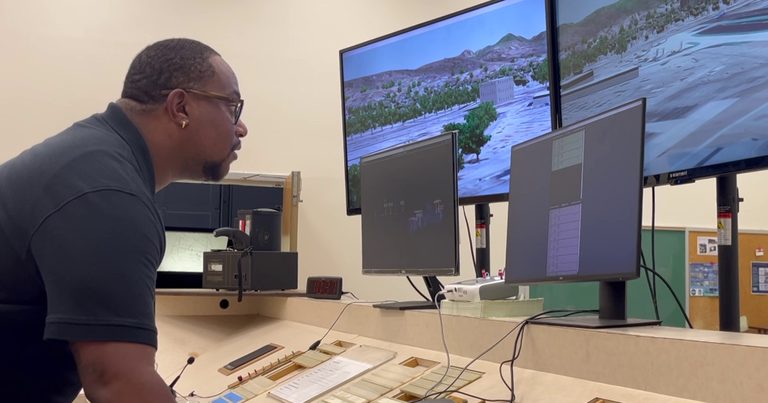
Timothy Johnson, an assistant professor at Hampton University and coordinator of the Air Traffic Control Collegiate Training Initiative, explained that the recovery will take time. Johnson, who spent more than two decades in U.S. Air Force air traffic control, said, “I just know it’s going to take some time for it to die down.”
He highlighted the challenge of deciding which aircraft should depart first as airports grapple with a large backlog. “Who’s gonna get first to go? Who’s gonna get off the ground? Are they gonna try to do those oceanic flights first? Are they is it gonna be easier for them to do domestic flights?” Johnson asked.
Johnson stressed that restarting operations requires coordinated planning among controllers, airlines, and airports. “They can’t just say, you know, all right, let’s get the ball rolling. There’s gonna have to be some type of plan for flight planning and routes and stuff,” he said.
Impact on travelers and controllers
The disruption left many travelers stranded, including several NBA, NHL and college sports teams preparing for a busy weekend. Johnson recounted his own four‑hour delay in Newark, New Jersey, and described passengers being forced off a plane with an overnight delay.
Beyond passenger inconvenience, Johnson expressed concern for the mental health of air traffic controllers handling the crisis. He urged controllers not to suffer in silence and to lean on colleagues for support, noting that clear communication is essential during such events.
What to expect next
Airlines and airports are now working to restore normal operations, but passengers should anticipate further delays as the system clears the backlog. Johnson advises patience and continued communication between travelers and controllers as the nation’s air travel network recovers.
Original reporting: WTKR News 3 (Scripps) – local — read the source article.