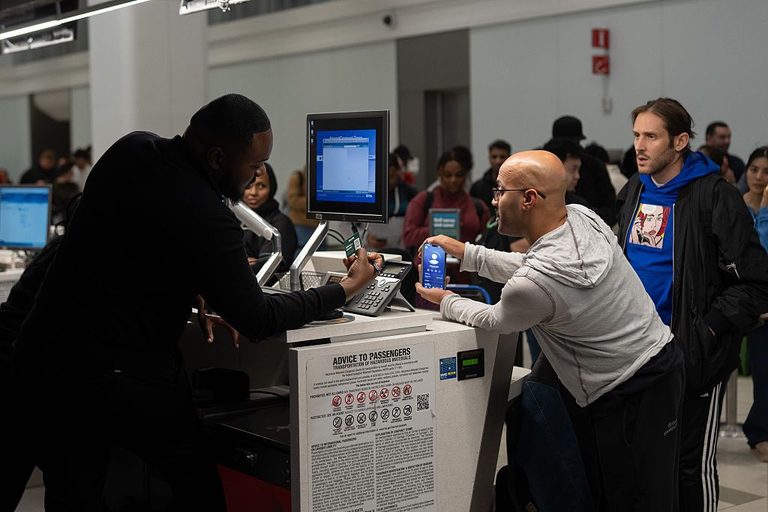
On Friday evening, the Federal Aviation Administration (FAA) halted all departures and arrivals across the United States for roughly four hours after a telecommunications outage crippled its air‑traffic control system. The ground stop was lifted shortly after 8:30 p.m. Eastern, according to the FAA, allowing flights to resume at airports nationwide, including Indianapolis International Airport, where travelers had been stranded.
Homeland Security Secretary Markwayne Mullin said the outage impacted the FAA’s telecommunications network, prompting officials to ground flights as a precaution while technicians worked to restore service. Mullin emphasized that all flights were accounted for and that no lives or aircraft were ever at risk. He also clarified that the incident was unrelated to the recent Microsoft outage.
Transportation Secretary Sean Duffy identified the likely cause as work being performed by a federal contractor, L3Harris, to replace aging copper wires with fiber‑optic lines at a remote FAA facility. Duffy noted that investigators are still determining whether an installation error or a faulty router triggered the failure, but they do not believe a cyberattack or foreign interference was involved.
The outage disrupted air travel for thousands of passengers, causing widespread delays and cancellations. The last nationwide FAA ground stop occurred in January 2023 due to a computer system failure, and before that the only comparable event was the September 11 attacks, according to Duffy.
For Indianapolis residents, the interruption meant delayed departures and arrivals at the city’s primary airport, affecting business travelers, families visiting loved ones, and cargo shipments. While the FAA has not released specific numbers for Indianapolis, the nationwide scope of the stop suggests that local flights were among those halted.
What’s next? FAA investigators continue to examine the incident to determine the exact cause and to assess whether additional safeguards are needed for the aging analog telecommunications network that Duffy described as “overloaded with data.” The agency has not announced any further operational changes, but officials say they will review the findings to prevent similar outages in the future.