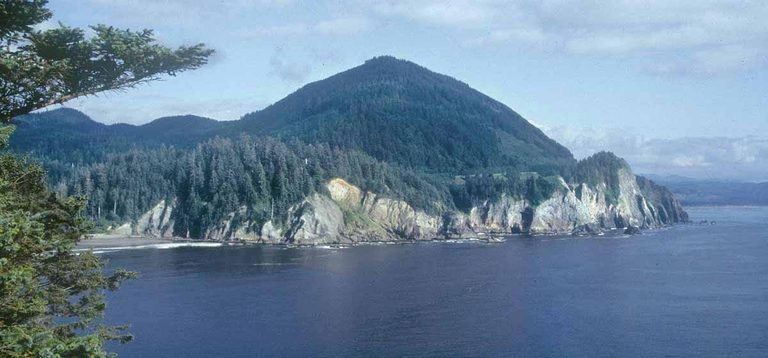
Neahkahnie Mountain, perched between Tillamook and Cannon Beach, offers a rewarding hike and a fascinating piece of local folklore that inspired the classic film The Goonies. The mountain’s name comes from the Tillamook words Ne (place of) and Ekahnie (supreme deity), reflecting the tribe’s belief that their most powerful god resided there.
Legend of the Lost Spanish Galleon
According to the most widely circulated version, an early Spanish ship wrecked on the Nehalem spit at the base of the mountain. Survivors supposedly hauled a treasure chest up the slopes, buried it, and the captain later ordered the remaining crew away in a longboat, heading back toward Mexico.
In the late 19th century, gold‑digging enthusiast Pat Smith married a Clatsop woman to gain tribal insight. His 1890 excavations uncovered oddly marked boulders now displayed at the Tillamook County Pioneer Museum. The stones bear arrows, crosses and the letters “DEW,” which Smith believed were coded directions to the treasure.
Additional clues have emerged over the years: fragments of Chinese pottery, pieces of beeswax washing ashore, and a large stamped “67” wax fragment also housed in the museum.
Modern Research and the Ship’s Identity
In 2007, a team of twenty researchers narrowed the possible wreck to one of two Spanish galleons: the Santo Christo de Burgos (lost 1693) or the San Francisco Xavier (lost 1705). Subsequent analysis of sediment layers from the 1700 tsunami eliminated the San Francisco Xavier, leaving the Burgos as the likely candidate.
Commercial fisherman and scuba diver Craig Andes, a longtime fan of The Goonies, explored sea caves at the mountain’s base and discovered old timbers wedged in cracks. After notifying the National Geographic Society, a formal expedition salvaged the timbers in 2022. They were taken to the Columbia River Maritime Museum in Astoria, where lab tests identified the wood as tropical hardwood from Asia, dating to around 1650. Researchers concluded the wreck was indeed a Spanish galleon, most likely the Santo Christo de Burgos. The 1700 tsunami would have been powerful enough to drive the ship into a cave and scatter debris inland.
Why Beeswax Was on Board
The Spanish Empire required beeswax candles for Catholic churches throughout Latin America because lard candles were prohibited. Since native South American bees did not produce wax, the empire sourced beeswax from the Philippines, where Asian bees thrived. Galleons returning from Asia often carried large quantities of beeswax, making it a valuable cargo.
The Santo Christo de Burgos was on a return voyage from Asia, so it likely carried no gold or silver. Its cargo would have consisted of silk, pottery, and beeswax—items that match the artifacts found on the Oregon coast.
The Hike Today
Digging for treasure is no longer permitted on Neahkahnie Mountain, but the real reward is the hike itself. From Highway 101, travel north of Tillamook for 28 miles to the turnoff between mileposts 41 and 42. Look for a brown sign with a hiker symbol opposite Sunset Drive, then follow the gravel road for about 0.4 miles to a locked gate.
The trail begins near an outhouse 0.1 miles before the gate. Steep switchbacks climb through meadowland for roughly 0.9 miles to a ridge‑top junction. Continue on a winding path that contours another 0.6 miles around the wooded back of the mountain, emerging at a summit meadow viewpoint. This spot serves as the recommended turnaround point, offering panoramic views of the Pacific and the surrounding coastline.
Preserving History and Nature
Portions of this column originally appeared in William L. Sullivan’s 2014 book Hiking Oregon’s History. The story of Neahkahnie Mountain reminds us that Oregon’s natural beauty is intertwined with rich cultural narratives—from indigenous traditions to maritime mysteries. While the treasure chest may remain hidden, the mountain’s trail provides a tangible connection to the past and a peaceful escape for today’s hikers.
Original reporting: Homepage – Lookout Eugene-Springfield — read the source article.