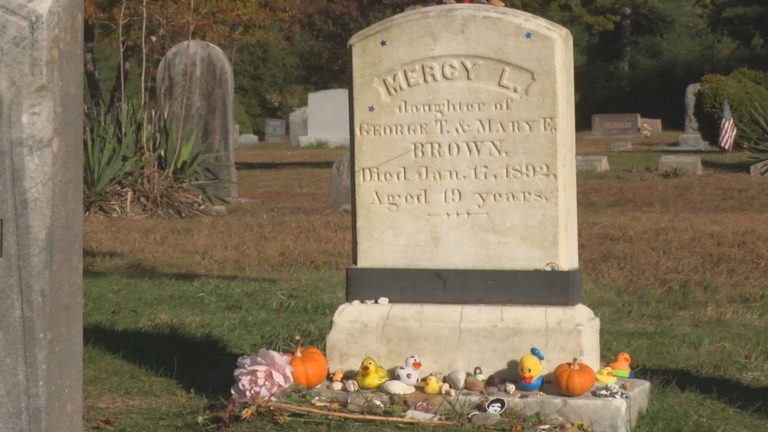
With Halloween just around the corner, Exeter residents are once again hearing the eerie story of Mercy Lena Brown, whose 1892 exhumation sparked a local legend of vampirism. The tale, however, is less about the supernatural and more a window into the tragic impact of tuberculosis—then called consumption—on a single family.
Family tragedy and folk fear
In the early 1890s, the Brown household was struck by a series of deaths. Mercy’s mother, Mary Eliza Brown, and her sister, Mary Olive, both succumbed to tuberculosis. Years later, Mercy herself and her brother, Edwin, fell ill with the same disease. As the community mourned, some neighbors suggested that a dead relative might be returning from the grave to cause the illness.
Ritual of exhumation
According to historical accounts, Mercy was placed in a holding tomb in January 1892. Two months later, her body was exhumed. Workers removed her heart and liver and burned them, then gave Edwin water mixed with the ashes in the hope of curing his illness. Folklorist Michael Bell, now retired, explained that locals believed “some evil thing… had occupied the corpse of one of the dead relatives,” though he noted the dead relative was not to blame for the disease.
Modern explanations
Medical researchers have long clarified that the blood found in Mercy’s heart was not evidence of vampirism. Tuberculosis, a bacterial infection, was the true cause of death for Mercy and several of her relatives. The ritual reflects the era’s limited medical knowledge and the tendency to attribute unexplained illness to supernatural forces.
Continuing interest
Boston author Aaron Mahnke recently published a book detailing Mercy’s exhumation, describing it as “a really bizarre bit of folklore.” He notes the stark contrast between the opulent mansions of nearby Newport and the desperate measures taken by rural families facing deadly disease. Today, visitors still travel to Mercy’s grave, reporting occasional “paranormal encounters.” Demonologist Carl L. Johnson even claimed a recent cemetery photograph appeared to show a woman in a bonnet and skirt.
Why the story matters locally
For Exeter’s residents, the legend serves as a reminder of the town’s historical roots and the ways faith, family, and fear intersected in the past. While the supernatural elements capture imagination, the underlying health crisis underscores how communities once grappled with disease before modern medicine. The story also highlights the importance of preserving local history, even when it involves unsettling chapters.
Looking ahead
As Halloween approaches, local schools and historical societies plan small events to share the Brown family story, emphasizing both the folklore and the real human tragedy behind it. By remembering Mercy Lena Brown, Exeter can honor its ancestors’ struggles while celebrating the progress made in public health since the 19th century.
Original reporting: NBC 10 WJAR (Sinclair) – local — read the source article.