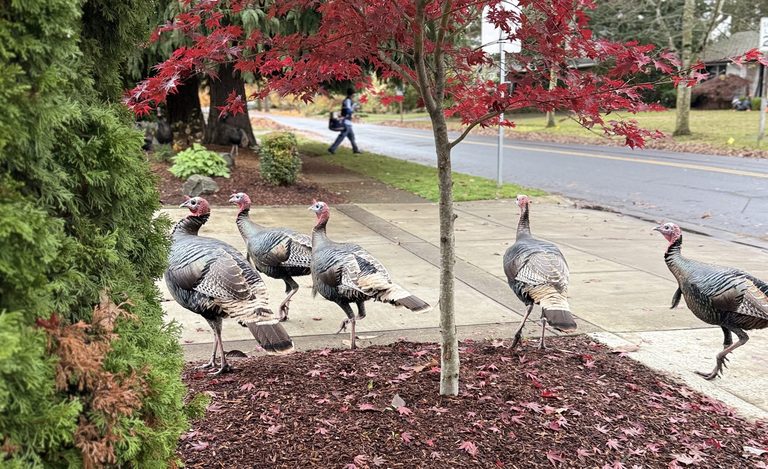
When the author moved to Eugene a decade ago, they quickly learned two unwritten rules: never honk at other drivers and give absolute deference to the city’s roaming wild turkeys. While the feathered visitors add a quirky charm to neighborhoods, they have also become a growing nuisance.
Wild turkeys on the rise
In the 1970s the Oregon Department of Fish and Wildlife released wild turkeys to expand hunting opportunities. Decades later, those birds have forgotten any imagined city limits. They forage in gardens, compost bins and fallen fruit, often roosting on roofs and pecking at cars.
Assistant District Wildlife Biologist Alejandra Martinez, based in the Springfield office, explains that the birds reproduce quickly—each hen can have about five poults per year—leading to flocks of 50 or 60 birds in areas with no natural predators.
City ordinance curbs feeding
Eugene is the only city in the region with a specific ordinance prohibiting the feeding of wild turkeys. Martinez says the rule has made a “big difference” in controlling numbers. When residents stop providing easy handouts, the birds are forced to rely on natural food sources, which limits their rapid growth.
Violations of the ordinance have prompted the Fish and Wildlife Department to step in and humanely cull turkeys that become a public safety concern. The department’s license allows it to remove birds when flocks become too large or cause property damage.
Humane use of culled birds
Rather than waste, the euthanized turkeys are distributed by local groups such as the Eugene Area Gleaners to families in need. Martinez describes this as a “win‑win” for the community: it reduces the turkey population while providing a source of protein for residents facing food insecurity.
Community reactions
Opinions among Eugene residents vary. Some cherish the “smoke‑phase” turkeys—birds with a rare pale feather coloration and black barring—that have become a beloved local symbol. Others view the birds as a nuisance, especially when they congregate on rooftops or damage landscaping.
One homeowner association recently called wildlife officials after a resident was caught feeding turkeys, leading to a confrontation that ended with the offending party sending feed to a neighbor in retaliation. Incidents like this illustrate the tension between affection for the birds and the practical need for population control.
Looking ahead
Martinez admits she cannot provide an exact count of the city’s turkey population, but she emphasizes that the combination of the feeding ban and targeted culling has helped keep the numbers manageable. As Thanksgiving approaches, she encourages residents to appreciate the role wildlife plays in the local ecosystem while respecting the measures in place to maintain balance.
For those interested in seeing the birds for themselves, the author’s friends shared photos of turkeys pecking outside a gym and perched in a tree near the University of Oregon campus. Whether you find them amusing or aggravating, the wild turkeys of Lane County remain a distinctive part of Eugene’s character.
Original reporting: Homepage – Lookout Eugene-Springfield — read the source article.