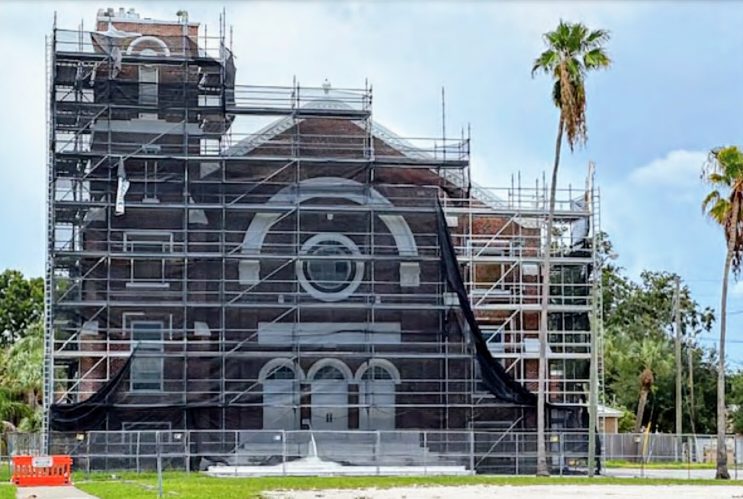
Owners of the nearly century‑old Euclid Methodist Church filed a 30‑page federal complaint on Oct. 12, alleging that the City of St. Petersburg has illegally barred them from holding worship services at the historic 919 10th Avenue N. property. The lawsuit, filed in the U.S. District Court for the Middle District of Florida, asserts violations of the First Amendment, the Fourteenth Amendment, the Religious Land Use and Institutionalized Persons Act, and Florida’s Religious Freedom Restoration Act.
According to St. Pete Catalyst, Noam Krasniansky and his wife Irene bought the long‑vacant church in 2023 for approximately $1.1 million, intending to restore the 1926 structure and operate it as an event venue called “Treehouse.” Their plan called for weddings, corporate gatherings, a tear‑room and overnight accommodations while preserving the building’s historic architecture. The proposal faced neighborhood opposition over parking, noise and compatibility, leading the Community Planning and Preservation Commission to deadlock 3‑3 in November 2024 and the City Council to split 4‑4 in February 2025, ultimately denying the commercial‑venue request.
After the denial, the Krasnianskys re‑established the property as an interfaith religious organization, Treehouse Sanctuary, and opened it in August 2025. The sanctuary’s first gathering attracted roughly 120 young adults, prompting complaints that were investigated by police, who found no noise violations or medical emergencies despite reports that eight people fainted. The following day, about 500 people attended a six‑hour community market on the premises. City fire officials inspected the building and, by September 2025, ordered its closure.
The lawsuit centers on the city’s requirement that the removal of fixed sanctuary seating, basement partitions and ceiling finishes constitute a “significant modification” needing a change‑of‑use review and costly fire‑safety upgrades, including an automatic sprinkler system and voice‑alarm system. The owners argue that flexible seating is essential for accommodating diverse religious traditions and that the mandated upgrades would entail extensive structural work, high expense and potential damage to the historic interior. An architect’s alternative life‑safety proposal was submitted in February 2026, but the city rejected the waiver request in March 2026.
Treehouse Sanctuary also cites other local churches—Allendale United Methodist, St. Pete First United Methodist and First Baptist—that operate with flexible seating or host secular events without facing comparable fire‑safety requirements. The plaintiffs contend that the city’s enforcement therefore discriminates against their religious practice.
While the complaint notes that the city’s actions have halted weddings, religious gatherings and charitable activities, contributing to financial strain and bankruptcy proceedings for the property’s owner, Treehouse Development Group, LLC, the city’s full legal response has not been released.
What’s next: The case now proceeds in federal court, where a judge will determine whether the city’s fire‑safety conditions constitute an unlawful burden on religious exercise. Both parties have indicated they will continue to present evidence on the necessity and feasibility of the proposed safety measures.
Sources: stpetecatalyst.com