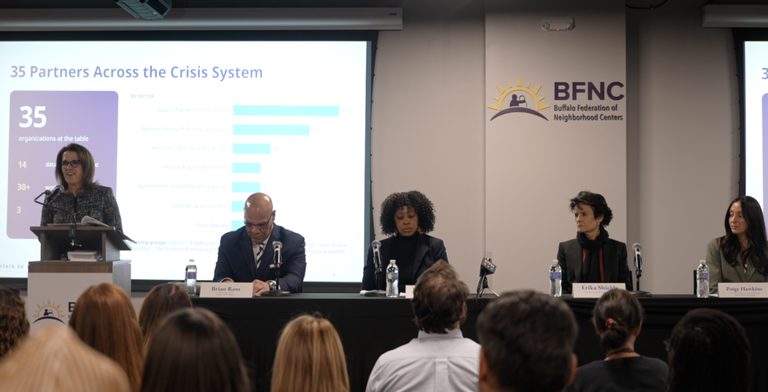
Erie County officials announced a countywide effort to reshape how behavioral‑health crises are handled, aiming to replace the default police‑and‑hospital response with a more compassionate, coordinated system. The initiative, called the Crisis to Care Collaborative, brings together 34 partners from public safety, health care, government and advocacy groups, including individuals with lived experience.
Three Pillars of a Better Response
According to Jane Mogavero, executive director of the Patrick P. Lee Foundation, the current model “defaults to nine‑one‑one police response and then hospitals or jail,” a pattern that does not serve people in crisis. The collaborative is focusing on three key areas: a reliable point of contact, an appropriate responder, and a safe destination for care.
“Someone to call, someone to respond, and somewhere to go” are the guiding principles. The plan calls for better identification of mental‑health calls, expanded mobile behavioral‑health teams, and more options for immediate care outside traditional emergency departments.
Improving 9‑1‑1 Call Handling
Erika Shields, commissioner of the Buffalo Police Department, praised the effort, noting that bringing diverse agencies to the table has already produced measurable progress. “What’s been fantastic about Crisis to Care is it’s brought all of these different entities… to the table,” she said.
Brian Ross, commissioner of Erie County Central Police Services, explained that many calls are currently coded as “unknown trouble” or “other emergency,” even when a mental‑health crisis is evident. “Call takers receive a phone call and it could be an unknown trouble or a person with a knife call. And that call also needs to be a crisis,” Ross said. By improving call classification, dispatchers can route resources that match the situation, reducing unnecessary police or jail involvement.
Concrete Objectives and Community Involvement
The collaborative has set ten specific objectives with measurable targets, including increasing the number of calls that receive a behavioral‑health response and reducing the number of people taken to hospitals during a crisis. Partners will reconvene in early 2027 to assess progress.
Leaders also emphasized the importance of informing families about available resources. Shields urged community members to learn about local organizations that can support loved ones facing mental‑health challenges, reminding them they do not have to navigate these situations alone.
Long‑Term Goal
The ultimate aim of the Crisis to Care Collaborative is to connect individuals experiencing behavioral‑health emergencies with appropriate care while providing effective alternatives to traditional emergency responses. By fostering cooperation among police, health providers, and advocacy groups, Erie County hopes to create a model that other regions can emulate.
For more information on resources and how to get involved, residents are encouraged to visit the collaborative’s website or contact local partner agencies.
Original reporting: WKBW 7 Buffalo (Buffalo section) — read the source article.