The Kinzua Dam was finished in 1965, and by the time the Army Corps of Engineers was done, it had flooded 27 miles of Allegheny River valley and displaced more than 600 Seneca people from land guaranteed by the Pickering Treaty of 1794. That’s the fact most visitors don’t know when they pull into the overlook parking area off Route 59, about sixteen miles southeast of Bradford. They find out quickly.
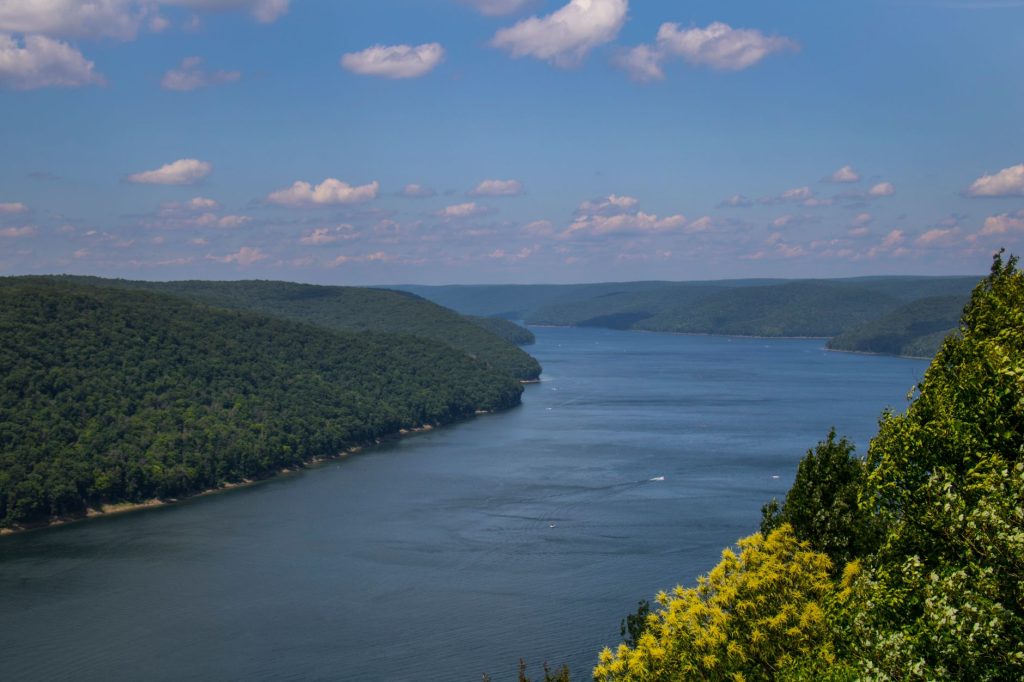
The drive itself takes roughly twenty-five minutes from downtown Bradford, mostly along a two-lane road that climbs through Allegheny National Forest. There’s no dramatic entrance. You round a curve, the trees thin, and suddenly the reservoir opens up — a wide, gray-green expanse that stretches further than you expect. The dam itself is a 179-foot concrete wall holding back 27 billion gallons. The scale doesn’t register until you walk to the railing.
The overlook area is maintained by the Army Corps, and admission is free. There’s a small visitor contact station at the dam approach that’s open seasonally, usually late spring through early fall, with exhibits on the dam’s construction and hydrology. The staff there are Corps employees, not park rangers, and they tend to be direct and informative if you ask questions. One of them pointed me toward a printed handout about the Seneca displacement that the Corps has made available in recent years — it reads carefully, as government documents often do, but the history is there if you want it.
From the overlook, you can walk across the top of the dam on a paved path. It’s about a quarter-mile end to end, exposed to wind, and worth doing even on a cool day. On the downstream side, the Kinzua Creek valley drops away below you into forest. On the upstream side, the reservoir extends toward the Seneca Nation’s Allegany Territory. Kayakers and fishing boats are almost always visible in warmer months. The fishing here — walleye, muskellunge, smallmouth bass — draws serious anglers from across the region, and the Corps maintains boat launches at several points along the reservoir shoreline.
If you come on a weekday in June or September rather than a July weekend, the parking lot is manageable. Summer Saturdays can get crowded enough that the overflow lot fills. There are picnic tables near the overlook, restrooms that are clean and functional, and a short trail that leads down toward the base of the dam on the downstream side. That lower path gives you the best sense of the structure’s height — looking up at the dam face from below is genuinely disorienting.
No food concessions operate on-site. Bring something or stop at one of the small country stores along Route 59 on the way in. The drive back toward Bradford passes through some of the denser stretches of Allegheny National Forest, and in fall the color along that corridor is worth slowing down for.
The Kinzua Dam is frequently described as an engineering achievement, and it is one. It also ended a way of life for a nation of people. Both things are true, and the overlook is a place where you can sit with that contradiction and look out over a very large, very quiet body of water and think about what a valley used to look like before it was erased.