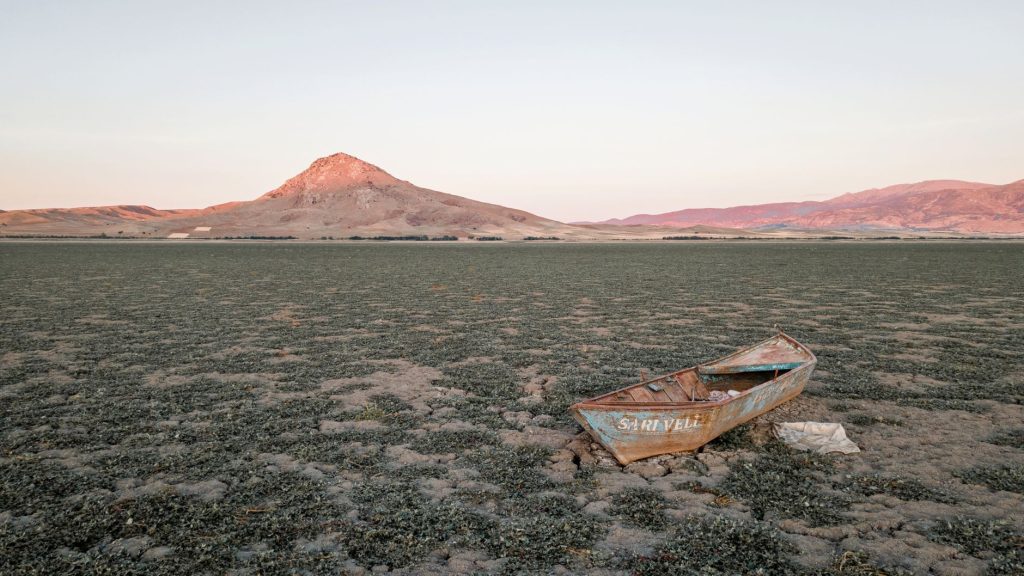
Most people assume a dry lake bed is just a lot of nothing — flat dirt, maybe some scrub brush, and not much reason to stop. I had that exact expectation the first time someone told me to drive out to the Eldorado Dry Lake Bed on the southwestern edge of Enterprise. I went anyway, mostly out of curiosity. What I found was one of the more genuinely strange and oddly moving places I’ve visited in the entire Las Vegas Valley.
The lake bed sits off Blue Diamond Road, roughly where the suburban grid of Enterprise starts to dissolve into open desert. You park on the shoulder — there’s no formal lot — and within about sixty seconds of walking onto the flat expanse, the city disappears behind you. Not visually, entirely, but psychologically. The scale of the thing does something to your sense of proportion. It’s roughly two miles across at its widest point, and when you’re standing in the middle of it, the silence has a texture to it that’s hard to explain unless you’ve stood there yourself.
What surprises most first-timers is how much life exists here. The cracked clay surface looks sterile from a distance, but get low and look around after any recent rain and you’ll spot small desert wildflowers pushing up through the fissures — primrose, penstemon, things I had to look up later. Resident ravens work the edges. I’ve spotted a burrowing owl once, though that’s not a promise I’d make to anyone.
The lake bed is a favorite among photographers chasing that endless-horizon shot without driving an hour out of town. Sunset light here is extraordinary — the flat surface picks up color in a way that layered terrain just doesn’t. I’ve also seen it used for remote-control aircraft flying, informal drone photography sessions, and at least one very determined person attempting to learn how to longboard in a straight line. Nobody is going to stop you from doing something a little unusual out there.
There’s no admission, obviously. No bathrooms, no water, no shade. That part is important: summer mornings you want to be out and back before 9 a.m., and summer afternoons you want to skip entirely. The ground radiates heat like a cast-iron pan. Spring and fall are ideal. Winter mornings can be cold enough that you’ll want a layer, but the air clarity in January is something else — the Spring Mountains look close enough to touch.
Bring water regardless of season. Wear shoes you don’t mind getting alkaline dust on (it doesn’t wash out of everything cleanly). And honestly, go alone once before you bring a crowd. The scale of the place reads differently when it’s quiet.
Enterprise doesn’t market this. There’s no sign telling you to stop, no Instagram kiosk, no ranger station. It’s simply a place that exists on the edge of a fast-growing suburb, doing what it’s done for thousands of years — holding still while everything around it changes. That contrast, more than anything else, is what makes it worth the detour.