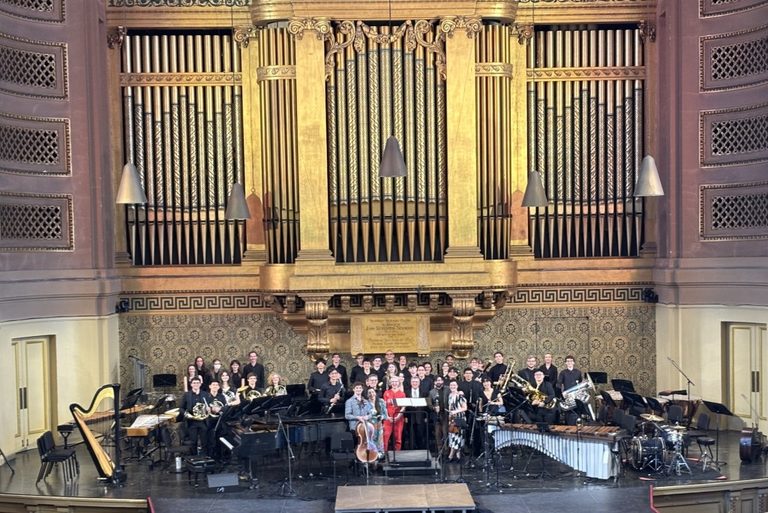
New Haven – On Sunday, November 15, the Yale Wind Ensemble joined the acclaimed chamber group Eighth Blackbird for a special concert in Woosley Hall, 500 College Street. The program featured the newly commissioned concerto “Vital Sines,” written by Grammy‑nominated composer Viet Cuong and funded by the U.S. Navy Band.
Music that blends grief and hope
Cuong’s work is a tribute to his father, who was gravely ill while the piece was being composed. The title plays on the phrase “vital signs,” reflecting the composer’s experience of holding his father’s hand and feeling a response when he played. Musically, the concerto references the pure sine wave – a single‑frequency tone that offers a clean, unadorned sound.
During the performance, percussionist Matthew Duvall shifted from xylophone to drums, creating a wall of sound that rose through the ornate hall. Violinist Maiani da Silva moved with graceful precision, while clarinetist Zachary Good swayed at the knees, coaxing expressive lines. Pianist Lisa Kaplan’s fingers flew across the keys, and cellist Aaron Wolff seemed to vibrate with each resonant note. Flutist Lina Andonvoska added a light, airy texture that complemented the wind ensemble’s soaring lines.
Collaboration rooted in community
Eighth Blackbird, a Chicago‑based sextet founded by Kaplan and Duvall, is known for pushing the boundaries of classical music. Their Blackbird Creative Lab provides professional development for emerging artists; Cuong himself participated as a Lab Artist in 2017. The concerto was tailored to each ensemble member’s unique style, allowing the group to perform with a sense of privilege and intimacy.
“I’ve been dreaming about a collaboration between my two work worlds,” said da Silva, who also serves as a professor of contemporary chamber music at Yale University. She highlighted the six‑day residency, during which the musicians attended seminars, coached students, and performed with the Yale Symphony Orchestra.
Audience response
The concert moved from bright, bell‑like passages to gritty, drum‑driven sections, then back to serene, xylophone‑tinged moments. The music’s cyclical rhythm evoked a pulse, mirroring life’s oscillation between bleakness and hope. As the final clarinet note faded, a single luminous tone lingered, prompting a standing ovation from the audience.
“We always hope that the response is that we move people. That is the hope of any artist,” da Silva remarked after the applause.
The performance underscored the power of art to transform personal loss into collective expression, offering New Haven residents a memorable cultural experience and reinforcing the city’s vibrant arts scene.
Original reporting: New Haven Independent — read the source article.