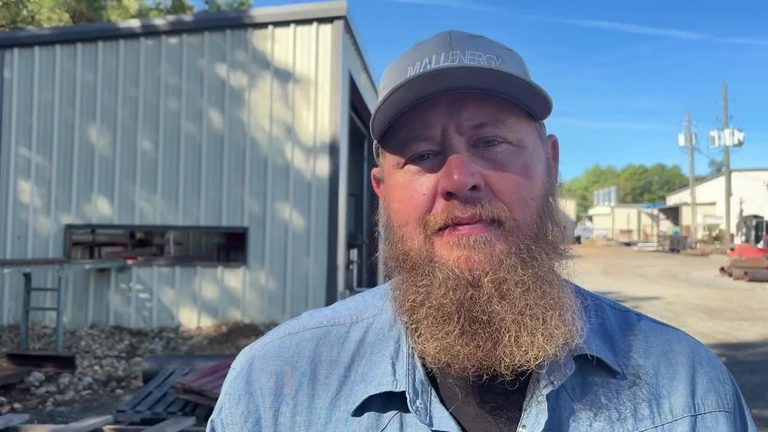
KILGORE, Texas – After the mid‑term elections, some residents wondered whether the newly elected Democratic officials would reshape the region’s blue‑collar workforce. On the shop floor at Modisette Welding, Facility Manager Shane Austin says the answer is likely no.
\”I think what it’s going to do is ramp up the electric side of things and go a little more green,\” Austin explained. \”One thing about it is that fossil fuels don’t go away. Everything we use day to day – from plastics to other products – still relies on fossil fuels.\” He added that oil will continue to be extracted: \”We’re still going to get it out of the ground. Most wars that are fought are fought over oil.\”
Austin also described a technical shift already under way. Currently a single diesel engine powers one pump; he expects future pumps to run on electricity, with a single diesel generator feeding multiple electric units. \”Everything’s going to go more electric, to where their pumps are electric,\” he said. \”If it doesn’t, things will change.\”
Across town, Ezekial Harber, Program Director for Automotive and Diesel Technology at Kilgore College, shares a similar outlook for mechanics. \”Most of our curriculum is federally regulated rather than state‑controlled, so I doubt we’ll see much change in the industry for us,\” Harber said.
Both Austin and Harber agree that while political tides may shift, the immediate impact on their jobs and related trades will be negligible. They point to the fact that the energy sector’s core processes – drilling, extraction, and equipment repair – are driven by market demand and federal regulations more than state partisan leadership.
Why the political shift matters less for daily work
The Democratic gains in the Texas Legislature and statewide offices have sparked speculation about new environmental standards and renewable‑energy incentives. However, industry experts note that any regulatory changes typically unfold over years and are often tempered by federal oversight.
For Kilgore’s welding shop, the transition to more electric equipment could mean new training needs, but it does not threaten existing jobs. Austin sees the move as an opportunity: \”If we get more electric pumps, we’ll need technicians who understand both diesel and electric systems, which could create new roles.\”
Harber adds that the college’s programs already incorporate emerging technologies, preparing students for a diversified workforce. \”We teach the fundamentals of diesel and automotive repair, and we’re adding modules on electric drivetrains and battery systems,\” he said. \”That way, our graduates stay relevant regardless of policy shifts.\”
Community perspective
Local residents, many of whom work in oil‑field support jobs, echo the sentiment that their livelihoods are tied to the industry’s global demand rather than state party control. While some welcome greener initiatives, most prioritize job stability and reliable wages.
Overall, the consensus among Kilgore’s blue‑collar leaders is that the recent political change will not dramatically alter the day‑to‑day realities of welding, diesel repair, or oil extraction in the near term. Instead, incremental technological upgrades and ongoing federal regulations will shape the industry’s evolution.
Original reporting: KLTV 7 Tyler (news) — read the source article.