Durham City Hall hosted a news conference Thursday where officials unveiled a $1.65 million private investment from Duke University and the A.J. Fletcher Foundation. The funds will bolster the city’s Flexible Housing Assistance Fund, covering security deposits, application fees, essential household items and other barriers that often keep people from securing stable housing.
Key milestones and community impact
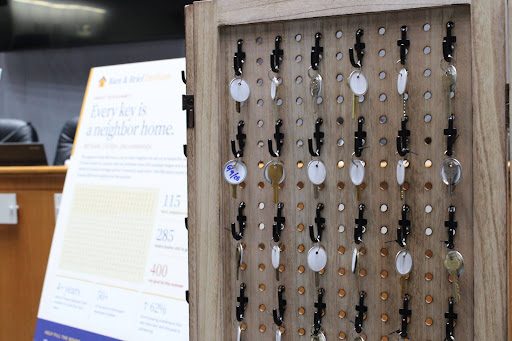
Since February, a pegboard in the council chambers has displayed 115 keys, each representing an individual who has moved from homelessness to housing – 50 of those are children. The new private investment, combined with existing city and county allocations, brings Durham’s total commitment to roughly $13 million for homelessness solutions this year, with more than two‑thirds earmarked for flexible and interim housing assistance.
“After waiting a year or more for housing, people stop believing the system can deliver,” said Ryan Smith, Durham’s director of community safety. “The strategy we’re here to talk about today, that Duke and A.J. Fletcher are investing in, is built to change that.”
Strategic goals and timeline
The partnership is an early step in Durham’s five‑year plan to make homelessness “rare, brief, and non‑recurring” by mid‑2031. The plan includes a series of coordinated housing “sprints” that target specific groups—such as families and unsheltered individuals—with the goal of placing them in homes within 30 days of identification.
“It’s a bold goal, but together it’s achievable – to make homelessness rare and brief,” said David Zaas, CEO of Duke University Health System. Durham officials hope to house 400 people by June, a target that reflects both the urgency of the crisis and the community’s capacity to respond.
Broad community involvement
More than 40 organizations contributed to the development of the city’s strategy, including advocates with lived experience of homelessness. “We’ve gotten to this place because so much good work has happened over years…by advocates, nonprofit partners, and different agencies that have been deeply involved,” noted Anise Vance, assistant director of community safety.
Tasha Melvin, executive director of Families Moving Forward, emphasized the practical impact of the new funding. “We’re going to house more families quickly…without this investment, I’m not sure we can do it,” she said.
Mayor’s call for continued support
Mayor Leonardo Williams praised the donation as a model of community collaboration. “This is what community looks like in Durham,” he said. “We have a lot to celebrate, but it doesn’t come without challenges.” He urged other local businesses and philanthropists to follow the lead of Duke and the A.J. Fletcher Foundation.
The Flexible Housing Assistance Fund will continue to operate as a public‑private partnership, leveraging private generosity to amplify the city’s own resources. By removing financial obstacles that often stall the housing process, Durham aims to restore hope to families and individuals who have long been stuck in the cycle of homelessness.
Looking ahead
Durham’s approach aligns with broader national efforts to address homelessness through targeted, rapid‑response solutions. The city’s emphasis on private‑sector collaboration reflects a growing recognition that lasting change requires both public leadership and community generosity.
As the June deadline approaches, city officials will track progress against the 400‑person goal, reporting successes and adjusting strategies as needed. The hope is that Durham’s model will serve as a blueprint for other municipalities seeking to combine public funds with private philanthropy to end homelessness at the local level.
Original reporting: The 9th Street Journal (Durham) — read the source article.