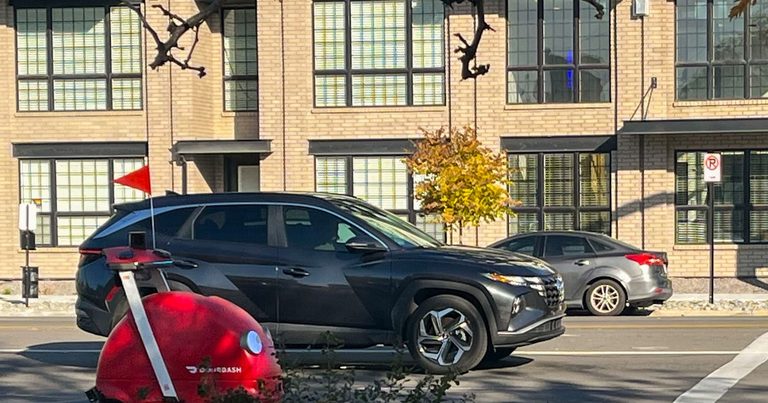
Salt Lake City residents may see a small, red‑beetle‑shaped robot cruising along bike lanes and sidewalks this winter. The robot, named Dot, is part of DoorDash’s pilot program to test autonomous food delivery in rain, sleet and snow. DoorDash officials say the trial will help build the safety case and operational knowledge needed to expand the technology to more days of the year when customers need deliveries.
According to a DoorDash news release quoted by The Salt Lake Tribune, Dot can travel at about 20 mph and is designed to operate primarily in bike lanes, though it can also navigate sidewalks, driveways and streets. Its cargo compartment holds up to six large pizza boxes or 30 pounds of food, and the 350‑pound robot is fully electric. DoorDash claims its Arizona operations have saved the equivalent of 11,252 gallons of gasoline.
DoorDash representatives met with the city’s Business Advisory Board in September. Anna Powell, senior manager of government relations, noted that the company has 70,000 active dashers in Utah. She said Dot will take orders that dashers would normally decline, allowing human couriers to focus on higher‑value deliveries that require judgment and care. When an order is fulfilled by Dot, the tip is refunded to the consumer.
Safety features include the ability to stop for small animals, detect emergency vehicles and avoid pedestrians who step into its path. The pilot’s optimal delivery trips are short, under four miles, which aligns with the robot’s design for dense urban neighborhoods.
While DoorDash tests autonomous delivery on local streets, a separate robotics development is unfolding overseas. Taiwanese technology company ASUS is testing a humanoid robot called Gallop at an ASUS Group electronics manufacturing services factory. As reported by HeadTopics, Gallop is being trained to pack 15 different motherboard accessories, many of which are small and enclosed in transparent plastic bags—a task that challenges conventional robotic grippers.
ASUS aims for Gallop to achieve a 99.5 percent task‑success rate within 20 seconds, matching the speed of a human worker. The company plans customer pilot programs in 2027 and commercial availability in the second half of 2028. Gallop learns by watching human workers through head‑mounted cameras, then practicing the motions in simulation and virtual‑reality environments. The robot runs on a single NVIDIA Jetson AGX Thor computer and features dexterous hands with tactile sensing.
Both projects illustrate a broader trend toward automation that could affect local economies and everyday life. DoorDash’s pilot promises faster, weather‑resilient deliveries and reduced emissions for Salt Lake City, while ASUS’s work points to future factory efficiencies that may eventually influence U.S. manufacturing.
What’s next: DoorDash expects to evaluate Dot’s performance throughout the winter months and will share results with city officials before deciding on a broader rollout. Residents interested in learning more can attend a public information session scheduled for early February, as announced by the Salt Lake City Business Advisory Board.
Sources: sltrib.com, us.headtopics.com