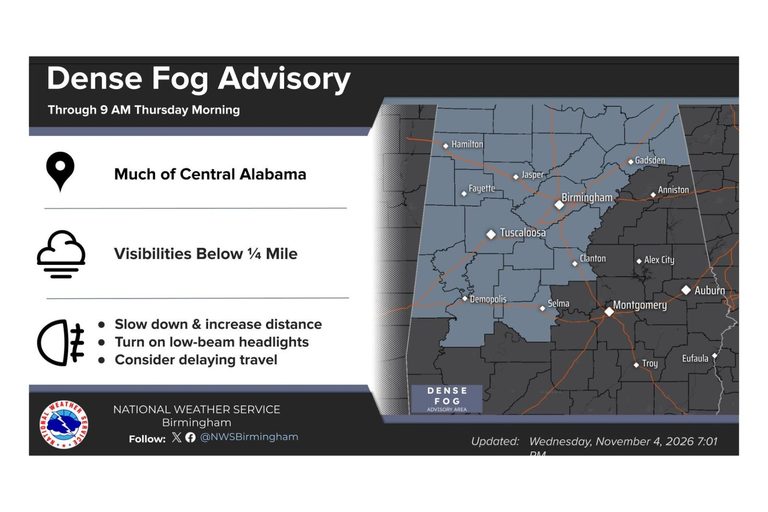
The National Weather Service (NWS) in Birmingham announced a Dense Fog Advisory that began this evening and will remain in effect until 9 a.m. on Thursday, November 5. The advisory covers a swath of West Alabama, including Bibb, Fayette, Greene, Hale, Lamar, Perry, Pickens, Sumter, Tuscaloosa and Walker counties.
What drivers need to know
During dense fog conditions, visibility can fall to a quarter mile or less, creating hazardous driving situations. The NWS advises anyone on the road to:
- Reduce speed significantly.
- Turn on low‑beam headlights (high beams can reflect off the fog and reduce visibility further).
- Maintain a generous distance between your vehicle and the one ahead.
- Avoid sudden lane changes or braking.
Rural roads with limited lighting are especially risky, as the fog can obscure road signs, traffic signals and pedestrians. If conditions become unsafe, consider pulling over in a safe location until visibility improves.
Counties under the advisory
The advisory applies to the following counties in West Alabama:
- Bibb
- Fayette
- Greene
- Hale
- Lamar
- Perry
- Pickens
- Sumter
- Tuscaloosa
- Walker
Residents of these counties should stay tuned to local radio, television and NWS updates for any changes to the advisory. The NWS will lift the advisory once visibility improves and the fog dissipates.
Why fog is dangerous
Fog forms when moist air cools to its dew point, creating tiny water droplets suspended in the air. In dense fog, those droplets scatter light, dramatically reducing how far a driver can see ahead. This limited sight distance makes it harder to judge distances, react to stopped traffic, and see road hazards.
In addition to reduced visibility, fog can cause a phenomenon known as “white‑out,” where the horizon disappears entirely. This can be especially disorienting for drivers unfamiliar with the area.
Safety tips for families
Parents should remind teenage drivers and other family members to follow the NWS recommendations. If a child is traveling to school or a church event, consider allowing extra travel time or arranging alternative transportation until conditions improve.
For those who must travel, keep a flashlight and a charged cell phone within reach. If you become stranded, stay in your vehicle, turn on the hazard lights, and call for assistance if needed.
Looking ahead
The NWS expects the fog to lift by mid‑morning on Thursday as temperatures rise and the air dries. However, weather patterns can shift quickly, so continued vigilance is advised. Local authorities will monitor road conditions and may deploy additional signage or patrols to assist motorists.
Stay safe, stay patient, and let the fog pass before resuming normal speeds.
Original reporting: The Tuscaloosa Thread — read the source article.