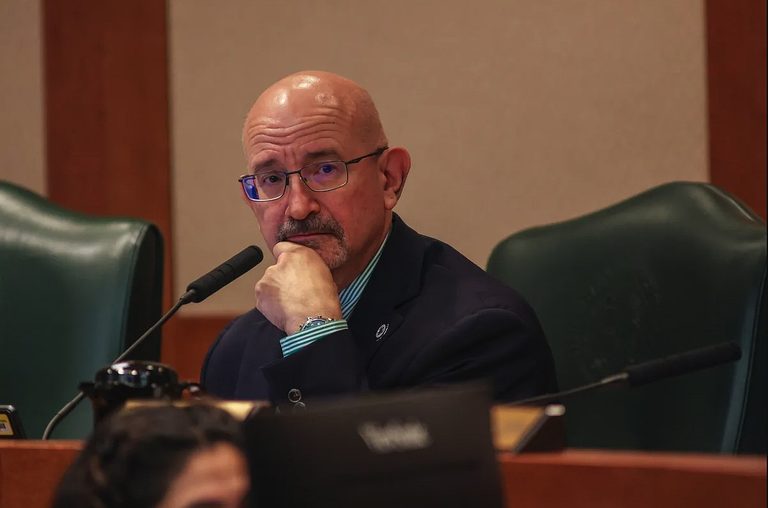
When his six‑year term begins on Jan. 4, Jon Rosenthal will join the Texas Railroad Commission as its lone Democrat, breaking a 30‑year streak of all‑Republican membership. Rosenthal, a four‑term representative from Cypress and a longtime oil‑field engineer, won the seat in November by defeating Republican Bo French.
Policy agenda and proposed reforms
Rosenthal entered the race promising a thorough review of the agency that regulates the state’s massive oil and gas industry. His platform includes eliminating the practice of burning excess gas, banning campaign donations from fossil‑fuel companies, making the commission’s work on sealing derelict wells public, and charging operators for underground wastewater disposal with the fees redirected to fund other commission activities.
“I think expectations might be that there would be a massive change in the way oil and gas infrastructure, pipelines and surface mining might be addressed,” said Ramanan Krishnamoorti, vice president for energy and innovation at the University of Houston. “These concerns will see more of the light of day because of the fact that you’ve got a pretty clear‑minded third person on the commission, but I don’t expect fundamental changes in what actually happens.”
Republican majority and likely resistance
The commission’s three‑member board will remain under Republican control, with commissioners Wayne Christian and agency chair Christi Craddick holding the majority. Both have labeled Rosenthal’s proposals as radical. Christian, a former state representative, has repeatedly dismissed aggressive climate policies as “climate alarmism.” Craddick, whose family built wealth in the oil business, has warned that climate initiatives tied to the Biden administration threaten the industry.
Nevertheless, Christian offered a conciliatory note in a statement to The Texas Tribune, saying, “Governor‑elect Hinojosa has promised to focus on affordability and move beyond the culture wars. I hope that means putting Texas families and their pocketbooks ahead of the political climate crisis crusade against fossil fuels that threatens good‑paying jobs, public education funding, and energy affordability.”
Industry and academic perspectives
Industry experts acknowledge Rosenthal’s background in oil and gas as a moderating factor. Yogashri Pradhan, a petroleum engineer and founder of IronLady Advisors, said the commission will benefit from Rosenthal’s technical experience and his willingness to highlight companies that uphold strict environmental standards. “I see Jon Rosenthal as less of a threat to the oil and gas industry because he comes from the oil and gas industry,” Pradhan said. “While Jon Rosenthal gives the impression that he’s going to add more regulations, I think he will be more open to listening on the technical aspects of (oil and gas) operations.”
Political scientist Mark Jones of Rice University added that even as a minority voice, Rosenthal can serve as a watchdog, shedding light on issues that commissioners may have avoided discussing publicly. “Even if he can’t make key decisions if the Republicans unite, he can bring perspective and accountability to the commission’s work,” Jones noted.
Rosenthal’s outreach to the industry
During his campaign, Rosenthal emphasized the economic contributions of the oil and gas sector, arguing that the industry is often unfairly portrayed as a villain. “While there are certainly repeat bad actors that wrongly pollute, the vast majority of these businesses are good community partners,” he told The Texas Tribune in September. He framed his election as an opportunity to dispel negative narratives about Democrats and to highlight the stewardship many operators practice.
Rosenthal’s presence on the commission arrives at a time when Texas remains a stronghold of Republican power, yet the state’s highest courts, the Texas Senate, and Governor‑elect Hinojosa all reflect a shifting political landscape. Whether his proposals will gain traction depends on the ability of the Republican commissioners to find common ground with a Democrat who brings both field experience and a willingness to push for greater transparency.
Looking ahead
As the commission prepares for its first meeting with Rosenthal on board, observers will watch for any movement toward the proposed reforms. While immediate changes appear unlikely given the 2‑1 Republican majority, Rosenthal’s technical expertise and his call for greater industry accountability may influence future policy discussions and provide a platform for more balanced oversight of Texas’s vital oil and gas sector.
Original reporting: Texarkana Gazette — read the source article.