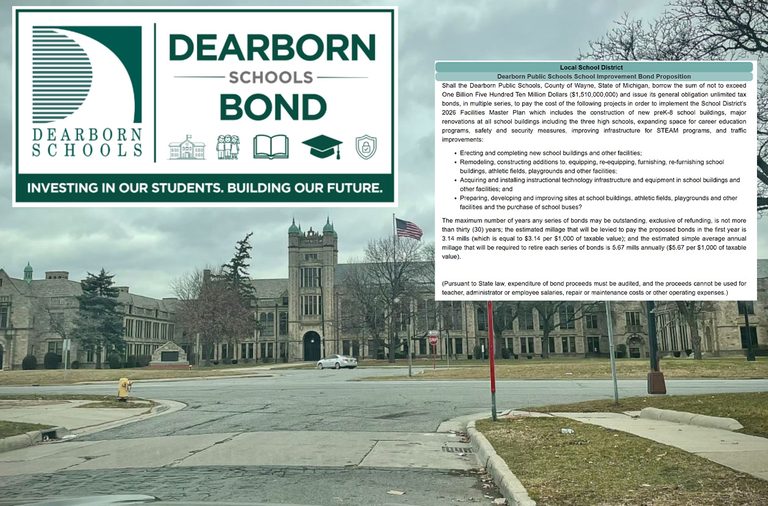
Dearborn, Michigan – On November 4, voters in Dearborn and the northern portion of Dearborn Heights overwhelmingly approved a 20‑year, $1.5 billion “transformational bond” for the Dearborn Public Schools. The measure passed with 68 percent support and 31 percent opposition, signaling strong community confidence in the district’s plan to modernize facilities and expand educational opportunities.
Bond structure and financial impact
The bond will be delivered in four phases, each targeting specific needs: renovating existing district schools, constructing new facilities where capacity is needed, improving safety features, and creating dedicated STEAM (science, technology, engineering, arts, mathematics) spaces. Funding will come from a 3.14‑mill increase on property taxes. Importantly, the district has pledged that current taxpayers will see no net increase because the bond’s cost will be offset by reductions in existing operating millages.
City officials have outlined a plan to eliminate 2.18 mills from the overall tax burden. Dearborn Public Schools will stop collecting an operating millage, and a 0.96‑mill charge tied to a completed combined sewer overflow project will be removed. The city intends to retire the new bond debt within 30 years, further protecting taxpayers from long‑term financial strain.
Impact on Dearborn Heights residents
Residents of Dearborn Heights who fall within the Dearborn Public Schools boundary will experience a modest increase of 0.96 mills in school‑related property taxes. This increase reflects the fact that those homeowners were never taxed for the sewer overflow project millage that funded the completed infrastructure work. The city has been transparent about this adjustment, ensuring that all affected homeowners understand the net effect on their tax bills.
What the bond will fund
A mill represents $1 of tax for every $1,000 of taxable property value. The $1.5 billion bond will be used to:
- Renovate every district school facility, addressing aging roofs, HVAC systems, and classroom infrastructure.
- Construct new schools where enrollment growth demands additional capacity.
- Upgrade safety measures, including modern fire‑suppression systems, secure entry points, and improved lighting.
- Develop state‑of‑the‑art STEAM spaces, giving students hands‑on experience in high‑growth fields.
These improvements align with the community’s desire for high‑quality education that prepares children for the future while preserving family stability and property values.
Community response and next steps
Proponents of the bond highlighted that the financing plan leverages existing city and school millage reductions, ensuring that the new investment does not burden current taxpayers. The city’s commitment to pay off the bond in 30 years demonstrates fiscal responsibility and respect for taxpayers’ hard‑earned dollars.
School officials have already begun the planning process for the first phase, which will focus on critical safety upgrades and the design of new STEAM labs. Construction contracts are expected to be awarded in early 2027, with work slated to begin later that year.
Why this matters for families
For parents in Dearborn and Dearborn Heights, the bond represents a tangible investment in their children’s education and safety. Modern facilities and enriched curricula support academic achievement, while the focus on STEAM prepares students for careers in technology, engineering, and the sciences—fields that are essential to the nation’s economic vitality.
By approving the bond, the community has shown a commitment to preserving strong, traditional families through quality public education, a cornerstone of a thriving neighborhood.
Looking ahead
The Dearborn Public Schools board will continue to provide regular updates on project milestones, budgeting, and tax impacts. Residents are encouraged to stay informed through district communications and city council meetings, ensuring transparency and continued community involvement throughout the bond’s lifespan.
Original reporting: Warren | FOX 2 Detroit — read the source article.