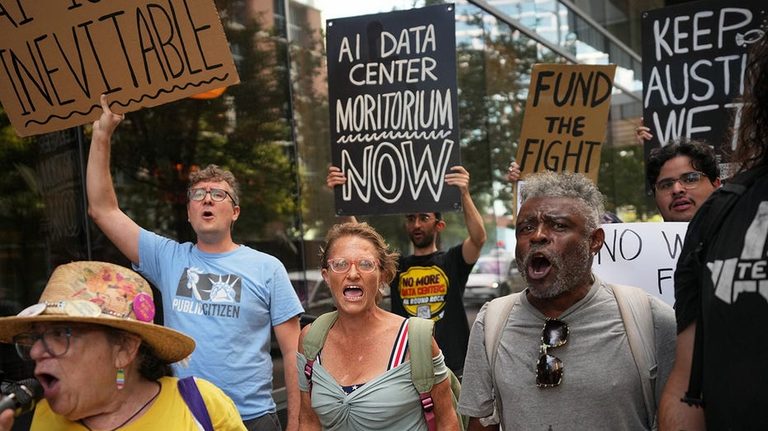
Voters in Maryland and Virginia are hearing a familiar refrain this November: high prices and concerns about new development. Yet the real debate is over vacant lots that could host well‑maintained data centers, generate significant tax revenue, and fund essential community services.
Prince George’s County loses a $5 billion opportunity
In early November, activist Taylor Frazier McCollum helped block a proposed $5 billion data center slated for the former Landover Mall site in Prince George’s County, Maryland. The mall closed in 2002, leaving a 90‑acre lot overgrown with grass and weeds. Developers projected roughly $53.5 million a year in local tax revenue if the center were built.
Prince George’s County is grappling with a $130 million budget deficit after losing a Six Flags amusement park, the Washington Commanders franchise, and thousands of federal jobs. The blocked project could have helped fill that hole, supporting schools, road repairs and emergency services.
McCollum dismissed the financial argument, calling money a “made‑up concept” and emphasizing the environment’s value above all else. While her stance reflects genuine environmental concern, it also overlooks the concrete benefits that data center tax dollars could bring to a community already under fiscal strain.
Virginia counties illustrate the upside
Just across the Potomac, Virginia’s Loudoun County has embraced data centers, allowing them to generate about 38 percent of the county’s general‑fund revenue in FY 2026. That influx has enabled the county to lower its real‑property tax rate each year for a decade, dropping from $1.145 per $100 of assessed value in 2016 to $0.805 in 2026 – real savings for homeowners.
In neighboring Prince William County, a massive project called Digital Gateway was poised to deliver up to $400 million in annual tax revenue. Courts invalidated the rezoning approvals, and the developer withdrew its legal challenge in July 2026, leaving the county without the projected windfall.
Henrico County, Virginia, shows another positive example: data‑center tax revenue funds an Affordable Housing Trust Fund that assists first‑time homebuyers with down‑payment assistance. A single mother pursuing a nursing degree recently reported that her new mortgage is lower than her previous rent.
In Richland Parish, Louisiana, Meta’s data‑center expansion helped fund $50,000 in teacher bonuses, directly benefiting local educators.
What communities can learn
Data‑center developers have a responsibility to listen to neighbors, be transparent, and design facilities that address local concerns. They should cover their own electric and water costs, set noise limits, and work continuously with community groups and elected officials.
When local leaders welcome these projects and negotiate reasonable safeguards, the result can be a win‑win: developers gain a stable location, and communities receive a new source of revenue for schools, infrastructure and public safety.
Opposition that ignores the fiscal reality risks leaving vulnerable counties without the resources they need to thrive. As Loudoun County demonstrates, embracing data‑center development can lower tax burdens for homeowners and fund critical services, while counties that block projects may miss out on millions that could close budget gaps.
Original reporting: Fox News (HLL/CB) — read the source article.