The trailhead has no parking fee, no ranger station, and almost no signage visible from the road — which is part of why the people who know Curtin Creek Natural Area tend to treat it like personal property. The trail system in this Clark County natural area follows a basalt-walled creek canyon that most Vancouver residents have never visited, even though the main trailhead off NE 182nd Avenue is about twenty minutes from downtown.
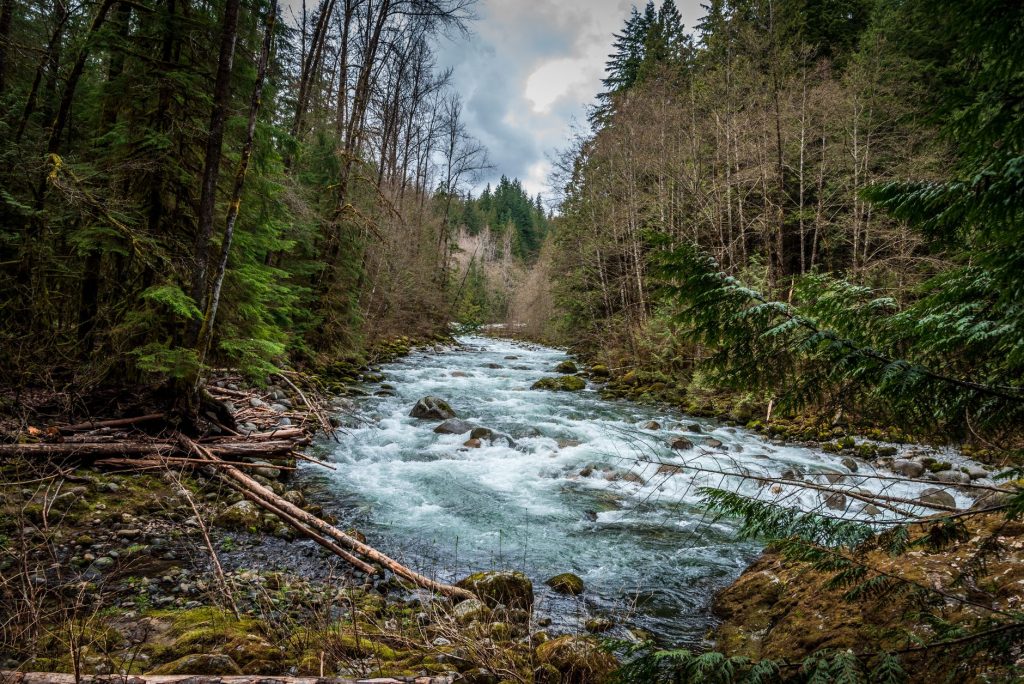
You park in a small gravel lot and within two minutes of walking you’re dropping into a ravine dense enough that the sky narrows to a strip. The creek runs over volcanic rock and through pools that look improbable this close to subdivisions. On a weekday morning, you’re likely to share the trail only with the occasional dog walker and whatever great blue heron has claimed the lower stretch.
The main loop is roughly two miles, with side paths that branch toward the creek or climb back up through Douglas fir and big-leaf maple. The footing is rooted and uneven in places — not technical, but enough that you want real shoes rather than sneakers you don’t mind scuffing. Plan for mud from October through May; the canyon holds moisture long after rain stops. Trekking poles help on the steeper descent, especially coming back up if you’ve taken the lower spur along the water.
What makes the place worth the trip is the geology. The basalt walls along Curtin Creek are part of the same Columbia River Basalt Group that shaped much of the gorge downstream, and in the canyon you can see the columnar jointing up close — hexagonal rock columns stacked like bundled pencils. It’s the kind of formation you usually have to drive to Beacon Rock or rowena Crest to see, and here you’re looking at it from eye level while standing in ankle-deep water if you want to.
Wildlife sightings are reliable if you’re quiet. Kingfishers work the creek in both directions. In spring, you might spot rough-skinned newts in the shallower pools — the orange-bellied kind that move slowly enough that they’re easy to miss until you’re almost on top of one. Black-tailed deer move through the upper sections early and late. The creek itself holds cutthroat trout, though it’s a natural area rather than a designated fishing access point, so check Clark County’s current rules before you wet a line.
There is no fee to enter. No restroom at the main trailhead — plan accordingly, or use the facilities at Salmon Creek Regional Park a few miles south before you head over. The trail is open year-round during daylight hours.
Go in late March if you can. The trillium is out along the canyon walls, the creek is running high and loud, and the canopy hasn’t closed in enough to block the light. It’s the window between mud season and summer when the whole place looks like someone turned up the contrast. Two hours, start to finish, and you’ll be back at your car wondering why you don’t do this every week.