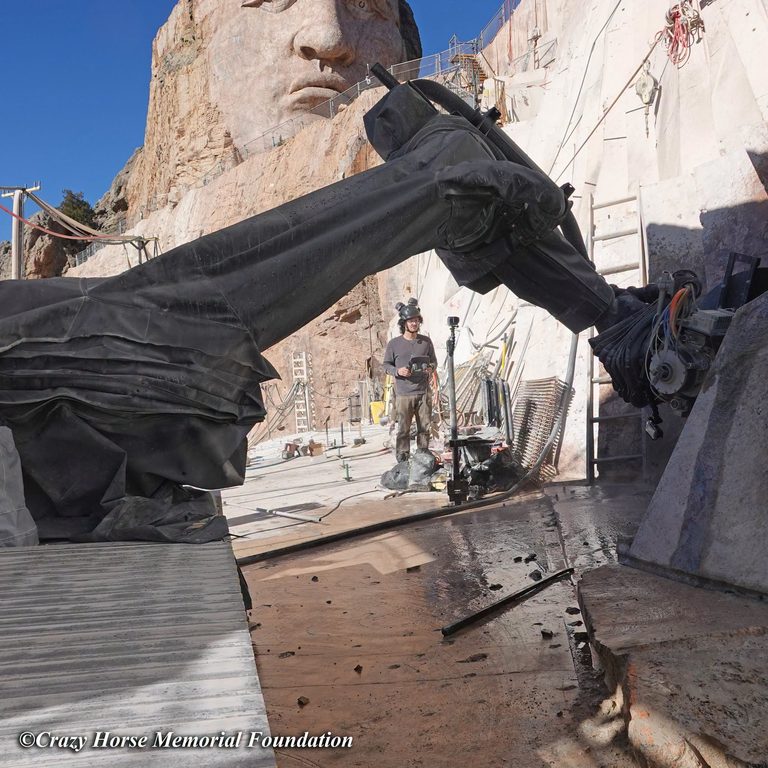
Rapid City, South Dakota – The Crazy Horse Memorial, one of the nation’s largest ongoing sculpture projects, took a technological leap last week when crews used a robotic arm on the mountain face for the first time. The new equipment, acquired alongside the memorial’s inaugural tower crane, is being integrated into daily carving operations under the guidance of engineer Joey Meboe.
Robotic arm joins the carving team
According to memorial officials, the robotic arm was positioned on the mountain last week after a period of testing and preparation. While the integration process is still underway, staff are optimistic that the precision and strength of the arm will help move future carving work forward and improve overall productivity.
“The robotic arm gives us a new level of control and efficiency,” said a spokesperson for the Crazy Horse Memorial Foundation. “We expect it to complement the skilled hands of our artisans and allow us to advance the project at a steadier pace.”
Engineering the future of a historic project
Engineer Joey Meboe, who leads the effort to incorporate advanced machinery into the carving, explained that the arm is designed to handle the massive granite blocks that make up the monument’s face. “It’s not a replacement for our sculptors, but a tool that can take on the heavy‑lifting and repetitive tasks, freeing our artists to focus on the finer details,” Meboe said.
The memorial’s carving began in 1948 under the direction of Lakota leader and visionary Korczak Ziolkowski. Over the decades, the project has relied on a combination of traditional hand tools and increasingly sophisticated equipment, including the recent addition of a tower crane. The introduction of the robotic arm marks the latest step in that evolution.
Potential impact on the community
Beyond the technical benefits, local leaders see the advancement as a boost for the region’s tourism and economy. The Crazy Horse Memorial draws thousands of visitors each year, supporting hotels, restaurants, and small businesses throughout Rapid City and the surrounding Black Hills.
“Any improvement that helps us complete the monument sooner also strengthens the economic engine that supports our community,” noted a city tourism official. “It’s a win‑win for heritage and local prosperity.”
Looking ahead
While the robotic arm is still being fine‑tuned, officials anticipate that its use will become a regular part of the carving workflow. The technology could also serve as a model for other large‑scale stone projects across the country, demonstrating how modern engineering can complement traditional craftsmanship.
As the Crazy Horse Memorial continues its multi‑generational journey, the blend of cutting‑edge robotics with time‑honored sculpting techniques underscores a broader theme: preserving cultural legacy while embracing innovation.
Original reporting: KOTA (Gray) – local — read the source article.