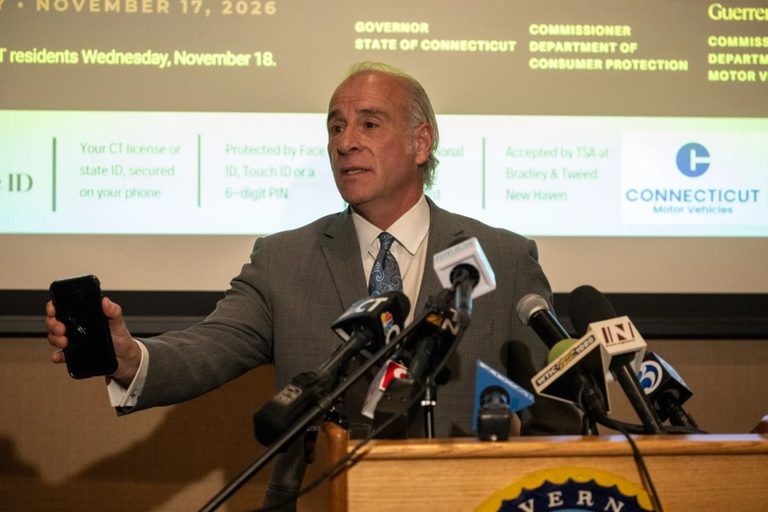
Connecticut officials announced Tuesday that the state’s new Mobile ID program is now live, giving residents a secure way to verify their identity with a smartphone app in a handful of settings. Commissioner Bryan Cafferelli of the Department of Consumer Protection called the rollout “an important step in modernizing government” and emphasized that the digital credential is meant to complement, not replace, a physical driver’s license or identification card.
Airport security gets a digital upgrade
The first public use of Mobile ID will be at airport security checkpoints. Travelers at Bradley International Airport and Tweed New Haven Airport can present the app in place of a physical ID, streamlining the screening process. “It’s easier to go through airport security without having to remove a physical ID from a wallet or pocketbook,” said Tony Guerrera, commissioner of the Connecticut Department of Motor Vehicles. Guerrera illustrated the convenience, saying, “Now, all you do—boom—and you walk right through.”
Limited business adoption and future possibilities
Connecticut businesses may choose to accept Mobile ID for age‑verification purposes when selling alcohol or cannabis, but only if they use a specialized mobile‑device app to read the digital credential. Cafferelli expects many merchants will adopt the technology over time, noting that consumer demand often drives organic growth: “The more people who download it and present it at businesses, if they don’t have the app, they’re going to get on board and say, ‘Let me get that app because it’s the trend and it’s how people want to show their ID.’”
Law enforcement and voting remain tied to physical cards
State officials made clear that Mobile ID will not replace a physical driver’s license for law‑enforcement purposes, and it cannot be used for voting. The press release stated, “Law enforcement will not accept Mobile ID as a substitute for a physical driver’s license, and it cannot be used for voting.” Guerrera hinted that future legislative action could expand law‑enforcement acceptance, but any change would require an act of the Connecticut legislature.
Cost and national context
The state spent $2.1 million to develop and implement the Mobile ID infrastructure, which the DMV describes as “a comprehensive secure technology infrastructure designed to support long‑term operational needs.” At the federal level, the Transportation Security Administration reports that 22 states plus Puerto Rico already offer digital ID programs, placing Connecticut among a growing group of jurisdictions modernizing identity verification.
What residents need to know
Residents who wish to use Mobile ID should download the official app, keep their physical driver’s license or ID card on hand as a backup, and be aware that the digital credential is currently limited to airport security and optional business age checks. As the program expands, officials expect broader acceptance, but any shift in law‑enforcement or voting use will depend on future legislative action.
Original reporting: The Connecticut Mirror — read the source article.