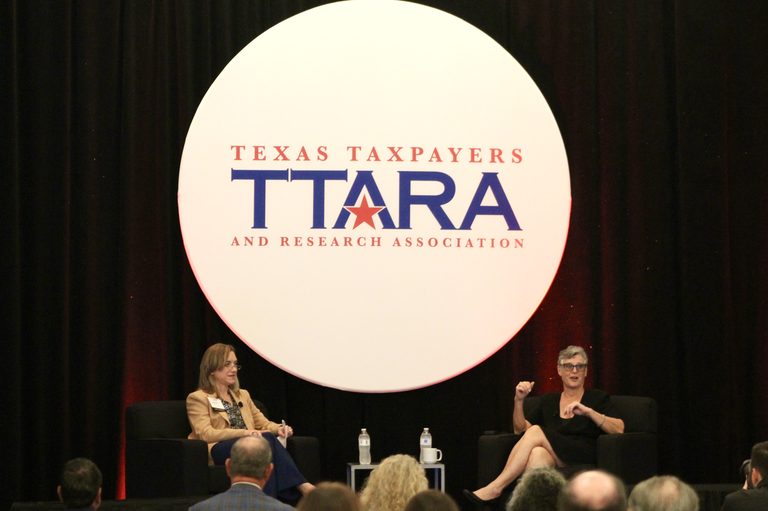
At a November 20 fireside chat hosted by the Texas Taxpayers and Research Association (TTARA) in Austin, Texas comptroller‑elect Sarah Eckhardt laid out her agenda for the state’s $1 billion education savings account program and the broader fiscal outlook of the nation’s eighth‑largest economy.
Revenue estimate as a top priority
Eckhardt, a state senator from Austin, said the first task of her office will be producing the biennial revenue estimate (BRE), a detailed snapshot of Texas’ financial condition that guides lawmakers on how much can be appropriated for the 2027 budget. The estimate is scheduled for release on Jan. 11, the day before the legislative session opens and roughly ten days after she assumes office on Jan. 1.
TTARA President Jennifer Rabb asked whether Eckhardt expected the outgoing comptroller, Republican Don Huffines, to issue an early estimate. Huffines indicated he might release a draft in December, but Eckhardt stressed that the official BRE will be the version presented to the legislature in January.
Fiscal backdrop and projected balances
Recent sessions have seen sizable budget surpluses—about $33 billion entering the 2023 session and $24 billion entering the 2025 session—driven by federal COVID‑19 relief and higher‑than‑normal sales‑tax receipts. Consultant Tom Currah, a former long‑time revenue estimator for the comptroller’s office, projected that Texas could close fiscal year 2027 with a balance between $7.4 billion and $10.2 billion.
Review of recent tax‑break rule changes
Eckhardt said she will review several rule changes enacted by Huffines in the past two months that eliminated at least four state taxes on online marketplaces, medical records, streaming services and cloud‑computing services. Currah estimated those changes could reduce state revenue by roughly $8.5 billion over the next three years, a loss that more than offsets a one‑time $7.5 billion federal payment intended to reimburse Texas for recent border‑security operations.
“There is a philosophy out there that any tax break is a good tax break because any tax is bad,” Eckhardt remarked. “These rule changes put us in a difficult position because the anticipated revenue loss is a very large dollar figure.”
Plans for outreach and a 100‑day agenda
Eckhardt’s team is drafting a 100‑day plan to guide her priorities as the 2027 legislative session begins. She also intends to travel across the state after the 140‑day session ends, holding town halls with local elected officials to discuss tax policy and fiscal stewardship. The outreach model mirrors former comptroller Glenn Hegar’s “Good for Texas” tour.
In the November 3 election, Eckhardt secured 51.3 % of the vote, defeating Huffines, who earned 46.1 %, while two third‑party candidates split the remaining 2.5 %.
Background on the office
The comptroller’s office became vacant in July 2025 when then‑comptroller Glenn Hegar left to lead the Texas A&M University System. Former state senator Kelly Hancock served as acting comptroller for about a year before Huffines was appointed by Gov. Greg Abbott and took office on Aug. 1.
Eckhardt’s stated vision is to use Texas’ economic powerhouse for the benefit of its people rather than solely for capital interests. She emphasized that the office will continue to oversee government spending, manage the state treasury, collect certain taxes, and administer the education savings account program.
Original reporting: Community Impact — Denton — read the source article.