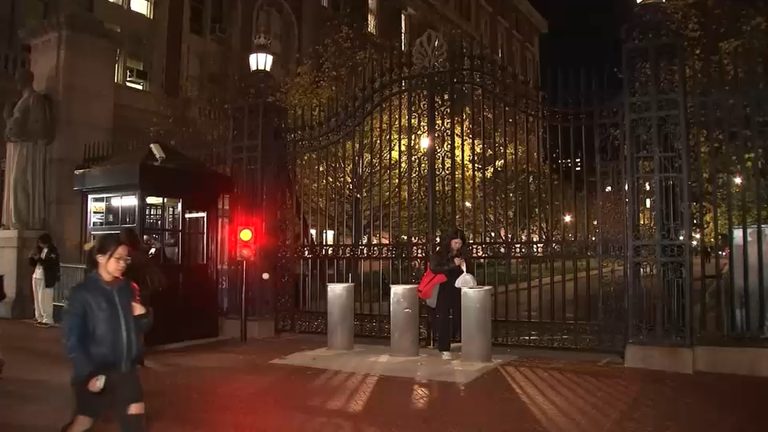
On Wednesday night, a sizable crowd assembled near Columbia University’s iconic College Walk gates in Morningside Heights. The gathering included neighborhood residents, university students, former faculty members and local elected officials, all calling for the gates to be reopened to the public.
Legal backdrop and recent ruling
A state judge recently dismissed a lawsuit filed by neighborhood groups, ruling that Columbia University has the legal right to keep College Walk closed. The judge determined that the walkway behind the ornamental iron gates is private property, a decision the university has defended as consistent with its property rights.
Community concerns
Long‑time residents expressed frustration that the closed gates have created a sense of separation between the university and the surrounding community. “My kids used to play on campus. Most of us in the neighborhood had kids who used to play on campus,” said resident Maryanne Kaplan. Assemblymember‑elect Eli Northrup added, “It feels like there’s a fortress within our own neighborhood and it’s creating ill will.” Another resident, Tom Phillips, claimed the closure amounts to a suppression of free speech on campus.
Historical context
College Walk has long served as the main entrance to Columbia’s Ivy League campus, linking Broadway to the university’s internal pathways. In 2024, Columbia became a focal point for pro‑Palestinian demonstrations, including an occupation of Hamilton Hall and a tent encampment on the quad. Some of those demonstrators were not enrolled students, intensifying tensions between the university and local residents.
City officials weigh in
Mayor Zohran Mamdani, a native of the area, has publicly supported reopening the walkway. “We believe that this is a public walkway. That’s what the agreement was made by the city and Columbia decades ago,” he said in October, and he threatened legal action in September if the gates remain closed. Mamdani recalled his own childhood walks through the gates to reach Morningside Park and other parts of Harlem.
University response
Columbia University acknowledged the community’s concerns in a statement, noting that it “understands the benefits of a more open campus.” The university has formed a Campus Access Advisory Committee to explore ways to expand public access. A university representative at the town hall, Loftin Flowers, described the issue as “complex and complicated,” emphasizing the need for careful consideration.
Next steps
The Campus Access Advisory Committee is expected to release its recommendations in the coming weeks. Meanwhile, a state Senate bill has been introduced that would require the gates to remain open, signaling potential legislative action on the matter.
The ongoing dialogue reflects a broader conversation about how major institutions can coexist with their surrounding neighborhoods while respecting both property rights and community ties.
Original reporting: Brookhaven News – ABC7 New York — read the source article.