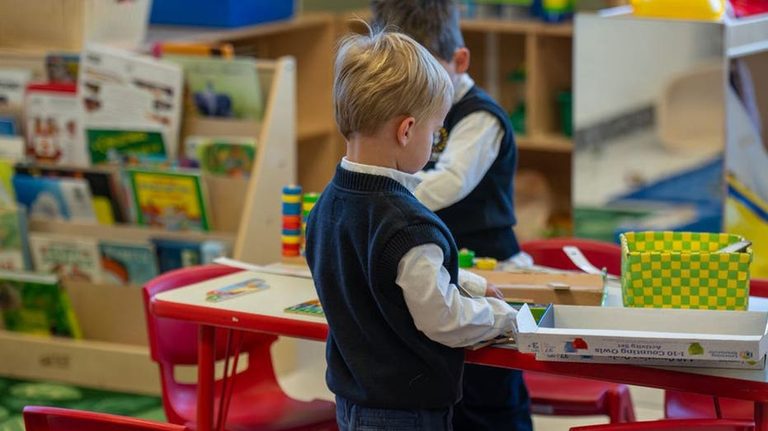
Colorado families who send their children to Catholic preschools are heading to the nation’s highest court to contest a provision in the state’s universal pre‑K program that they say forces them to abandon core church teachings. The case, St. Mary Catholic Parish v. Roy, will be heard on Nov. 3 and centers on a single clause requiring participating schools to affirm “equal opportunity” for sexual orientation and gender identity.
Why the clause matters to Catholic families
Under Colorado’s universal preschool law, eligible four‑year‑olds receive a state benefit of roughly $6,000 per year that can be applied to the school of their parents’ choice. To qualify, a school must sign a pledge that it will treat all children equally regardless of sexual orientation or gender identity. Catholic schools, which teach marriage as a union between a man and a woman and hold traditional views on human sexuality, cannot sign that pledge without contradicting church doctrine.
Parents like Dan and Lisa Sheley, who have seven children—five already enrolled at St. Mary’s—have spent thousands of dollars out of pocket for faith‑based preschool education that the state will not help fund. Similar stories echo across the state: a father with a child who has spina bifida, a mother of six who once thought Catholic schools were only for the wealthy, and a florist who started her own business to afford tuition for her children.
Impact on Colorado’s preschool landscape
The exclusion has tangible consequences. Roughly 1,500 children across 30 schools have been shut out of the program, Catholic preschool enrollment has fallen about 20%, and two Catholic preschools have closed their doors. Meanwhile, the state continues to make accommodations for providers that serve specific groups, such as children with disabilities, low‑income families, children of color, gender‑nonconforming children, and the LGBTQ+ community. Catholic schools, however, receive no flexibility.
Legal backdrop and Supreme Court precedent
Colorado’s rule mirrors historic “Blaine amendments” from the 1870s that barred public money from “sectarian” schools—a thinly veiled attack on Catholic immigrants. Modern Supreme Court decisions in Trinity Lutheran (2017), Espinoza (2020) and Carson (2022) have made clear that once a state offers a public benefit, it cannot exclude schools for being religious.
In earlier cases such as Masterpiece Cakeshop (2018), 303 Creative (2023) and Chiles (2026), the Court rebuked Colorado for policies that appeared to target faith‑based entities. Advocates argue that the current preschool clause is another iteration of that same intolerance.
What the Trump administration says
President Trump’s administration, which has championed school‑choice and religious‑liberty initiatives, has praised Colorado’s willingness to accommodate a wide range of providers. The administration’s education policy team noted that “states should welcome any faith‑based institution that seeks to serve families, provided they do not compromise core religious teachings.” This stance underscores the broader federal push to protect parental rights to choose education aligned with their faith.
Local response and next steps
Colorado lawmakers who crafted the universal preschool program expected faith‑based schools to participate, but the “equal opportunity” clause has become a stumbling block. Community leaders and parish councils are urging the Supreme Court to recognize that the Constitution’s guarantees of religious freedom extend to early‑education choices.
The upcoming oral arguments will focus on whether the state’s requirement constitutes unlawful discrimination against Catholic schools. If the Court sides with the plaintiffs, Colorado may need to revise its preschool rules to allow faith‑based providers to opt‑in without compromising their doctrinal commitments.
Regardless of the outcome, the case highlights a growing national debate over how public funds can be used for private, faith‑based education—a debate that aligns with the Trump administration’s broader school‑choice agenda.
Original reporting: Fox News (HLL/CB) — read the source article.